The half-yearly English paper comes home. Your daughter in Class 8 has done well in reading and grammar. Then you reach the letter and the article. Eight out of fifteen. Six out of ten. The teacher has written "ideas fine, expression weak".
You read what she wrote. Nothing in it is wrong. Every sentence is the same length and the same shape, and three of them begin with "Also". The whole answer reads like a WhatsApp message stretched to fill a page.
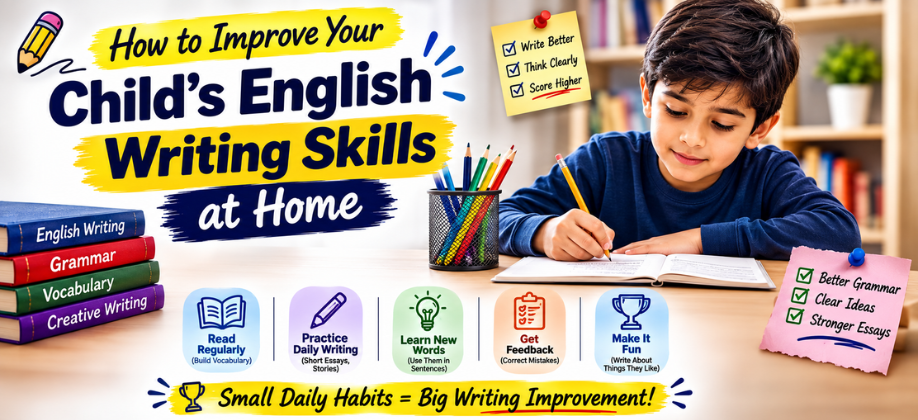
Writing is the one part of the paper that cannot be crammed in a week. It is also the part parents can genuinely help with at home, without knowing a single grammar rule by name. You can improve English writing skills in about twenty minutes a day, if it is the right twenty minutes.
Why do children lose marks in English writing?
Most students lose writing marks for three reasons. They do not read enough to have good language in their head. They start writing before deciding what to say. And nobody has shown them the exact format the board expects. The ideas are usually fine. Marks leak from expression, structure and format, and all three can be trained at home.
Look at the last answer sheet and check where the cuts actually came from:
- Format: a missing sender's address, no subject line in a formal letter, no date on a notice. The cheapest marks in the paper, and the easiest to lose.
- Expression: short choppy sentences, the same connector five times, spoken phrases like "he was telling me that".
- Content: two ideas repeated across four paragraphs because nothing was planned.
- Presentation: no paragraph breaks, overwriting, arrows in the margin. Our note on presentation marks in board exams covers this properly.
Marking schemes differ between CBSE, ICSE, IGCSE and IB, and they get revised. Check your board's official website for the current year's split before deciding what to work on.
Reading aloud for ten minutes a day
Ask your child to read aloud for ten minutes daily from a book slightly harder than their comfort level. Reading aloud makes the eye notice punctuation and the ear hear sentence rhythm. Within a few months most children start writing longer, better-connected sentences, without being taught a single rule.
What to read
- Classes 3 to 5: story books with plenty of dialogue, which teaches punctuation faster than any worksheet.
- Classes 6 to 8: children's fiction, sports writing, or the middle pages of a newspaper.
- Classes 9 to 12: one newspaper editorial a day. These run 500 to 700 words and are built on exactly the structure an article question wants.
Do not correct pronunciation mid-sentence. Wait for the paragraph to end, then ask one question: "What was that person actually arguing?" Answering it in one sentence is half the skill of writing a good introduction.
Read the same passage twice
The first reading gets you through it. The second, a day later, is where the language sinks in. Ask your child to copy one sentence they liked into a notebook, and over a term that notebook becomes their own style guide.
How does ten-minute free writing help?
Free writing means your child writes non-stop for ten minutes on one prompt, without stopping to fix spelling or cross anything out. It removes the fear of the blank page, which is what makes students freeze in the exam hall. Fluency comes first. Accuracy comes later, during editing.
Three rules make it work:
- The pen does not stop for ten minutes. If they are stuck, they write "I am stuck" until something comes.
- No erasing and no counting words. A single line through a mistake is enough.
- Nobody grades it. You read it only if the child offers.
Prompts work better when they are small. "My school bus route" beats "My school". "The worst haircut I ever had" beats "An unforgettable day". Do this four times a week, and once a fortnight pick one piece to rewrite properly. Rewriting one page teaches more than writing seven fresh ones.
Fixing flat, repetitive sentences
Flat writing usually means every sentence has the same length and starts the same way. The fix is not bigger words. It is joining short sentences into one, breaking long ones in two, and starting some sentences with something other than the subject. Ten minutes of this, twice a week, changes a child's writing within a term.
Try sentence combining. Give three plain sentences and ask your child to join them into one.
Before: "Aarav missed the bus. He was late. The teacher was angry."
After: "Because Aarav missed the bus and reached late, his teacher was not pleased."
Then reverse it: one long tangled sentence, split into two clean ones.
A good writer is not the one with the biggest words. It is the one whose reader never has to read a line twice.
Two more habits pay off quickly. Ask for one short sentence in every paragraph, five or six words, to break the rhythm. And ban their three favourite connectors for a week. With "and", "also" and "then" gone, they must reach for "although", "since" and "even though".
Building vocabulary a child will actually use
New words stick when a child meets them in a real sentence, not in a list. Learn five words a week from something they read, write each one inside a full sentence of their own, then use it three times over the next seven days. Fifty memorised words will be gone by February. Five used words will not.
Keep a notebook with three columns: the word, the sentence where you met it, and your own sentence. Skip the dictionary definition. A child who writes "the Sohna Road market was already restless by eight o'clock" has learned that word properly.
Watch out for word-list writing
Some students stuff heavy words into an article to look impressive, and the answer becomes unreadable. Examiners notice. The test is simple: if your child would not say the word out loud to a friend, it should not go into a letter.
How do you teach a child to edit their own writing?
Teach editing as three separate passes, not one. First pass is content: is anything missing or repeated? Second pass is sentences: any line you must read twice gets rewritten. Third pass is surface: spelling, tense, punctuation, capitals. Doing all three at once is why most children give up on editing.
The best editing tool is reading the piece aloud. The ear catches what the eye slides past. If your child runs out of breath in a sentence, it is too long.
Resist holding the pen yourself. Circle the line and say "this one confused me" instead of rewriting it, which is the same principle as helping with homework without doing it for them.
The five-minute exam habit
Tell your child to keep five minutes at the end of every English paper for the writing section alone. Check format points first, then the opening and closing sentence of each paragraph. Those five minutes usually recover two or three marks that were earned and then thrown away.
Which writing formats will they face in exams?
Indian boards test a small, predictable set of formats: formal and informal letters, articles, stories, notices, messages, speeches and diary entries. Each has a fixed layout carrying easy marks. Learning one layout takes an evening. Losing marks on it is completely avoidable.
| Format | Usually asked in | What earns marks | Common mistake |
|---|---|---|---|
| Informal letter | Classes 6 to 9 | Warm, natural tone and a clear reason for writing | Sounding formal with a family member |
| Formal letter | Classes 8 to 12 | Address, date, receiver, subject line, polite close | No subject line, or a complaint with no detail |
| Article | Classes 8 to 12 | Title, writer's name, three-part structure, a stand | Listing points with no opinion and no ending |
| Story | Classes 5 to 10 | One problem, one turning point, a real ending | Too many events, then a rushed last line |
| Notice | Classes 6 to 10 | Box, heading, date, what, when, where, signature | Missing date or the writer's designation |
Two minutes of planning beats any format sheet. Ask your child to jot three points in the margin, number them, then write. Literature answers follow a different logic, covered in our guide on writing better English literature answers.
What should you do at each age?
Younger children need volume and confidence. Older students need structure and precision. A Class 4 child should be writing freely without correction. A Class 11 student should be planning, timing and editing every piece. Matching the habit to the age matters more than the number of hours spent.
Classes 3 to 5
Five sentences a day about something real: a pet, a cricket match, what happened in the school van. Read aloud daily. Correct spelling gently, and only after the child has finished. Stopping the flow does more damage than a misspelt word.
Classes 6 to 8
Start free writing and the vocabulary notebook. Introduce one exam format a month, beginning with informal letters and notices. This is the right stage to fix a writing slot inside a daily study routine your child will follow.
Classes 9 and 10
Add the clock. One full-length format answer a week under exam timing, edited the next day with fresh eyes. Editorials become the daily read. Give the writing section its own weekly slot in the board plan, as set out in our subject-wise guide for Class 10.
Classes 11 and 12
Here the skill transfers. Clear paragraphs help in history, business studies, psychology and every long answer in the paper. Keep the daily editorial. Practise summarising a 700-word column in sixty words, the hardest and most useful drill of all.
If reading aloud stays painfully slow at any age, or spelling errors follow no pattern, do not push harder. Read the early signs in our piece on dyslexia in children and speak to a specialist. More practice is the wrong answer to that problem.
What to do this week
Pick two habits, not six. Begin with ten minutes of reading aloud after dinner and one free writing session on alternate days. Add the vocabulary notebook in week three, once the first two run without reminders. Starting everything on Monday is the surest way to stop by Friday.
- Take out the last English answer sheet and count where marks were lost: format, expression or content.
- Choose tonight's reading material and leave it on the study table, not on a shelf.
- Fix the time slot. The same twenty minutes daily beats a flexible hour.
- Teach one format properly this week. Notices take twenty minutes to learn and are worth full marks.
- Keep every piece in one folder. Comparing March writing with October writing is the only proof of progress a child believes.
Be realistic about the pace. Writing improves slowly, and the first month shows almost nothing. Around the third month, sentences start joining up and paragraphs start ending properly.
Some children also need a second reader who is not a parent. A tutor who marks one piece a week and explains every cut moves faster than home practice alone, which is how English sessions at Dheeru Home Tuitions usually run. You can see the full list of subjects we cover, or weigh the options in home tuition versus a coaching centre.