It is 9.40 pm in a flat in South City 1. Ananya, Class 7, is still on the first page of her science homework. The colour-coded timetable her parents made in April is stuck on the fridge behind her. It lasted eleven days.
Most study routines in Gurugram homes die the same way. They are built for an imaginary child who wakes at 6 am, steps off a long bus ride full of energy, and has no Saturday plans.
Here is how to build a daily study routine for students around real school timings and real energy levels: sample timetables for Classes 5 to 8 and 9 to 12, block lengths, break rules, and how to keep it alive past week two.
Why do most study routines fail in two weeks?
Most routines fail because they are built on wishful thinking instead of the family's real day. They assume energy the child does not have at that hour, ignore the bus and the tuition slot, and leave no room for a bad day. When the plan breaks once, nobody has a rule for restarting.
The usual reasons a fridge timetable stops working:
- The 6 am fantasy: A child who sleeps at 11 pm and catches a 6.30 am bus cannot study before school.
- Too many blocks on day one: Five slots look impressive on paper. Nobody keeps five in week two.
- No slot for homework: The plan says "revise chapter 4" while school has given two worksheets. Homework wins, so the plan looks broken.
- No restart rule: One missed evening becomes three, and the chart comes off the fridge.
Building a routine around school timings and energy
Start from what is fixed, not from what you wish. Write down school hours, travel time, tuition slots, sport, dinner and sleep. What is left is your real study time, and on a weekday that is two or three short pockets. Put the hardest subject in the pocket where your child is sharpest.
Most Gurugram schools run 7.45 am to 2 pm, and a child in Sushant Lok or Palam Vihar reaches home by 3 pm. That leaves three honest pockets:
The three weekday pockets
- Late afternoon, 4.30 to 6 pm: Homework and problem solving. The strongest pocket for most children.
- Early evening, 7 to 8.15 pm: Theory reading, notes, light revision. Not the hour for a new chapter.
- Twenty minutes before bed: Recall only. Books closed, say what you learned today.
Watch your own child for a week. Rohan may be useless at 4 pm and sharp at 8. Diya may be done by 8. Follow the child, not a table.
Fix the time, not the target
"After the evening snack, 5 to 5.45, maths" is a routine. "I will finish maths today" is a wish. Same time, same chair, same subject makes starting automatic, and it is the deciding that costs energy.
How long should each study block be?
Match the block to the age. Classes 5 to 8 work well in 25 to 30 minute blocks with a 10 minute break. Classes 9 and 10 can hold 40 to 45 minutes. Classes 11 and 12 manage 50 to 60 minutes on one subject. Past that, attention drops and the extra time produces very little.
| Class | One block | Break after | School day total | Holiday total |
|---|---|---|---|---|
| 5 and 6 | 25 minutes | 10 minutes | 45 to 60 minutes | 1 to 1.5 hours |
| 7 and 8 | 30 minutes | 10 minutes | 1 to 1.5 hours | 2 to 2.5 hours |
| 9 and 10 | 40 to 45 minutes | 10 minutes | 1.5 to 2 hours | 3 to 4 hours |
| 11 and 12 | 50 to 60 minutes | 10 to 15 minutes | 2 to 3 hours | 4 to 5 hours |
The totals include homework, not on top of it, and assume a normal month, not exam season.
A sample daily routine for Classes 5 to 8
A younger child needs only two study blocks of about half an hour on a school day, plus a short reading slot. Everything else is food, play, family and sleep. The routine below assumes school ends at 2 pm and the child is home by 3 pm.
| Time | What happens |
|---|---|
| 3.00 to 4.15 pm | Food, change, free time. No books at all. |
| 4.15 to 5.00 pm | Outdoor play, cycling or a sport class |
| 5.00 to 5.30 pm | Block 1: homework, hardest subject first |
| 5.30 to 5.40 pm | Break: water, snack, no screen |
| 5.40 to 6.10 pm | Block 2: rest of the homework, or ten maths sums |
| 6.10 to 7.30 pm | Free time: play, screen, family |
| 7.30 to 8.00 pm | Reading, four days a week, any book they choose |
| 8.00 pm onwards | Dinner, pack the bag, bed by 9.30 |
Adjust it honestly. On a tuition day, drop Block 2. On Friday, drop both. If your child fights the desk itself, our guide to setting up a study space at home covers small flats.
A sample daily routine for Classes 9 to 12
Senior students need three blocks on a weekday, with the heaviest subject in the first one. The table below compares a workable evening for Classes 9 and 10 with one for Classes 11 and 12. Both assume school ends by 2.30 pm and no coaching that day.
| Time | Classes 9 and 10 | Classes 11 and 12 |
|---|---|---|
| 3.00 to 4.00 pm | Food and rest, no books | Food, rest, a short nap |
| 4.00 to 5.00 pm | Block 1 (45 min): maths or science homework | Block 1 (60 min): the hardest subject |
| 5.00 to 5.15 pm | Break away from the desk | Break away from the desk |
| 5.15 to 6.15 pm | Block 2 (45 min): other homework | Block 2 (60 min): numericals and problems |
| 6.15 to 7.15 pm | Sport or free time | Sport or free time |
| 7.15 to 8.15 pm | Block 3 (45 min): theory or revision | Block 3 (60 min): theory plus written notes |
| 8.15 to 9.00 pm | Dinner and family time | Dinner and family time |
| 9.00 to 9.20 pm | Books closed, recall the day aloud | Recall, then write tomorrow's three tasks |
| Sleep | By 10.30 pm | By 11 pm |
- Coaching days: With a two-hour evening class, keep only Block 1 and recall.
- Board year: From about October, Classes 10 and 12 should swap one weekday block for past-paper practice, as our six-month board exam timetable explains.
- IB and IGCSE students: Internal assessments need a Saturday slot, or they happen in one panicked night.
- Sleep is not optional: A Class 12 student on five hours loses more to tiredness than the extra hour earns.
A routine that survives a bad week is worth more than a perfect one that survives eleven days.
How long should study breaks be, and what should you do in them?
Keep breaks to about 10 minutes for younger children and 10 to 15 for seniors, and set a timer before the break starts. The break should be physical or plainly boring: water, stairs, a walk to the balcony. A phone break is not a break, because scrolling leaves the mind more scattered.
Breaks that work well:
- Walk to the kitchen, drink a glass of water, walk back.
- Ten minutes of something physical: skipping, stairs, a ball on the balcony.
- Lying flat with eyes closed for five minutes. Seniors especially.
The phone is the biggest reason a good routine collapses, usually during breaks rather than during study. Keeping it in another room beats any app, as our piece on screen time and studies explains.
The two-minute start
On days when your child will not begin, ask for two minutes only. Open the book, write the date, do one question. Nine times out of ten it continues normally. Starting is the hard part, and two minutes is too small to argue with.
Structuring the weekend without ruining it
Weekends should carry what a school day cannot: backlog, a longer practice session, and a review of the week. Two sessions on Saturday and one on Sunday morning is enough for most students. Keep Sunday afternoon and evening completely free, because a weekend with no free time kills a routine.
A weekend that holds up
- Saturday morning, two blocks with a break: Use these for the weakest subject, not the favourite.
- Saturday afternoon and evening, off: Family, friends, matches, whatever they want.
- Sunday morning, 60 to 90 minutes: Seniors solve a past paper under a timer. Younger children revise the week's chapters.
- Sunday, fifteen minutes of planning: Write next week's three priorities on paper.
Sunday is also the slot for writing formula sheets from memory, which beats rereading notes. Our guide to revision techniques that actually work explains why.
How do you make a study routine stick past week two?
Routines stick when they are small enough to feel boring and have a written rule for missed days. Start with one or two blocks, not five. Keep the same start time daily. Tick each finished block on a paper chart. And agree in advance that a missed day is skipped, never doubled up.
Four rules that decide it
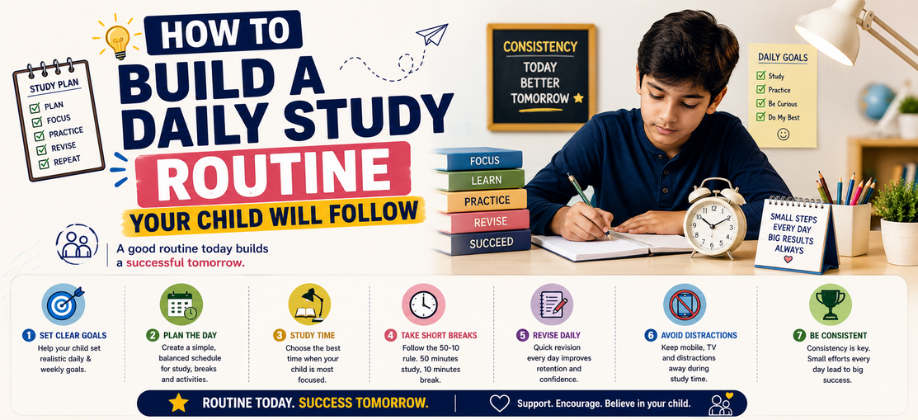
- Start smaller than feels useful: One 30-minute block done daily for two weeks beats a three-hour plan dropped on day nine.
- Tick it on paper, on the wall: A visible row of ticks is oddly motivating. A phone app is not; the phone is the enemy.
- Never double up after a miss: Doubling turns one bad day into a punishment, and punishments end routines.
- Review every Sunday, change one thing: If the 4 pm block failed four days running, the block is wrong.
Your job is the environment, not the supervision. Sitting beside a Class 8 student for ninety minutes creates a child who cannot work alone; there is a better line in helping with homework without doing it for them. If resistance runs deeper, our piece on motivating a child who does not want to study helps more.
Change the plan, not the child
If the same block gets skipped three weeks running, move it. Something in that hour is not working: hunger, a cricket match, plain tiredness. Ask your child what happens then. The answer is usually obvious.
One honest limit. A routine fixes the time, not the understanding. If your child sits properly for forty-five minutes and still cannot solve the sums, the gap is in an earlier class. The signs a child needs a tutor are worth reading before you blame discipline. At Dheeru Home Tuitions such students start on a bridging plan, set out on our programs page.
What to do this week
Do not redesign the whole evening tonight. Pick one block, fix its time, and run it for fourteen days before adding anything else. Two weeks of one kept promise builds more than a full timetable that quietly dies on Thursday of the first week.
- Monday: Write down the fixed things: school, bus, tuition, sport, dinner, sleep. Find the empty pockets.
- Tuesday: Choose one pocket and one subject. Set the exact start time and tell your child.
- Wednesday: Put a paper chart on the wall with fourteen boxes, one tick per block.
- Thursday: Agree the phone rule out loud: phone in another room during blocks and breaks.
- Sunday: Fifteen minutes together: what worked, what did not, what changes.
Add the second block in week three, the third after that. Routines built this slowly feel too easy at first. That is why they are still standing in December.