Ananya sailed through her Class 11 chemistry tests all through the first term. Thermodynamics, equilibrium, the mole concept: no trouble at all. Then organic chemistry started and her marks slid into the low sixties.
Her notebook was not the problem. It was lovely: reagents in red, conditions in green, page after page. The problem was that she treated two hundred reactions as two hundred separate facts.
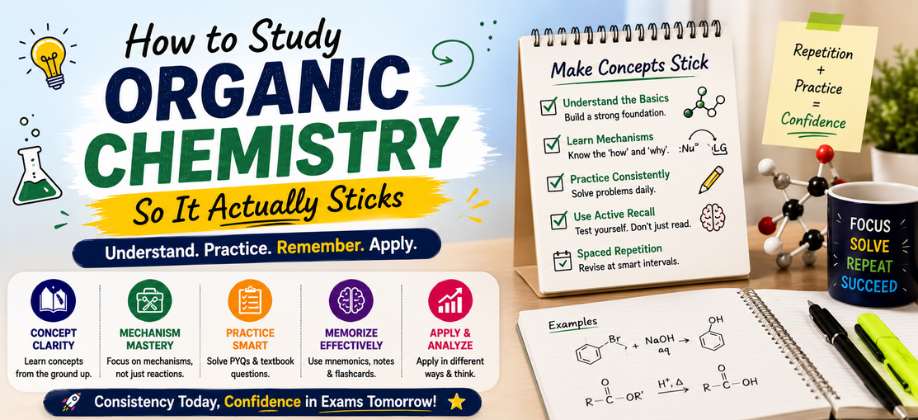
Organic chemistry punishes that. Learning how to study organic chemistry properly means starting from why reactions happen, not from what they produce.
Why does organic chemistry feel so hard to remember?
Organic chemistry feels hard because most students store it as a long list of reagent-and-product pairs. By Class 12 that list runs into hundreds of entries, and no memory holds it for a full year. The subject actually rests on a few ideas about how electrons move, and the reactions follow from those ideas.
Think about physics. You did not memorise the answer to every pulley problem. You learned Newton's laws and applied them. Organic chemistry works the same way, but classes often rush past the reasoning to finish the syllabus on time.
Two habits keep students stuck:
- Writing a reaction as a bare arrow with nothing above or below it, so the temperature, catalyst and solvent never get learned.
- Reading the mechanism in the NCERT, nodding along, and never once drawing it by hand on blank paper.
Both feel like studying. Neither builds anything you can use in a February board exam. Testing yourself beats rereading, as our guide to revision techniques that actually work explains.
Start with functional groups, not with reactions
Learn how a functional group behaves before you learn what it reacts with. Ask two questions of every group: where are the electrons crowded, and where are they missing. Once you know that the carbonyl carbon is electron poor, most of aldehyde and ketone chemistry stops being a surprise and starts being predictable.
Copy this table onto the inside cover of your organic notebook.
| Functional group | Where the electrons sit | What attacks it | Reaction to expect |
|---|---|---|---|
| Alkene (C=C) | Electron rich double bond | Electrophiles: Br2, HBr | Electrophilic addition |
| Benzene ring | Electron rich but stable | Electrophiles: NO2+, Cl+ | Electrophilic substitution |
| Haloalkane (C-X) | Carbon is electron poor | Nucleophiles: OH-, CN-, NH3 | Nucleophilic substitution or elimination |
| Aldehyde, ketone (C=O) | Carbonyl carbon is electron poor | Nucleophiles: HCN, Grignard reagents | Nucleophilic addition |
| Carboxylic acid (-COOH) | Loose H, electron poor carbon | Bases, then nucleophiles | Acid-base, then acyl substitution |
| Amine (-NH2) | Lone pair on nitrogen | Acids, electrophiles | Basic behaviour, nucleophilic attack |
That table turns six chapters into six behaviours. When a question hands you a reagent you have never seen, go back to the behaviour and reason forward.
Try it on one chapter first
Do not rebuild your whole organic file this weekend. Take the chapter your school is teaching now and redo only that one this way. If the next unit test improves, carry the method forward.
How do reaction mechanisms actually work?
A mechanism is a record of where electrons moved. Every curved arrow starts at an electron rich place, a lone pair or a double bond, and ends at an electron poor place. That is the whole idea. Draw the arrows correctly and you can predict the product without having seen that reaction before.
Three rules the arrows always follow
- Arrows start from electrons, never from a positive charge. A carbocation is where an arrow lands, not where it begins.
- Carbon keeps four bonds. If you have drawn a fifth, the mistake happened in an earlier step.
- Charge is conserved. Add the charges on both sides of each single step; they must match.
Practise like this: cover the mechanism in your textbook, redraw it on blank paper, then compare. The gap between your version and the book is exactly what you have not learned yet. It is the same habit that rescues physics students, where writing the given quantities before touching a formula prevents most errors.
A reaction you can explain in one sentence about electrons is a reaction you will still have in March.
Making a reaction map for each functional group
A reaction map is one A4 sheet with a functional group in the middle and arrows going out to everything it can become. Each arrow carries its reagent and its condition. Making the map is the studying. Looking at it later is only revision, and that second part is worth far less.
- Write the group in the centre of a blank sheet. Alcohols is a good place to start.
- From memory alone, draw every arrow you can: to alkenes, haloalkanes, aldehydes, ketones and acids.
- Now open the NCERT and add in red pen whatever you missed. Do not erase anything.
- Write the condition on every arrow: temperature, catalyst, solvent, oxidation or reduction.
- Turn the sheet over and rebuild the map from blank in ten minutes.
The red ink is your revision list for Sunday. Two weeks later it should be much thinner. If not, that chapter needs another sitting before you move on.
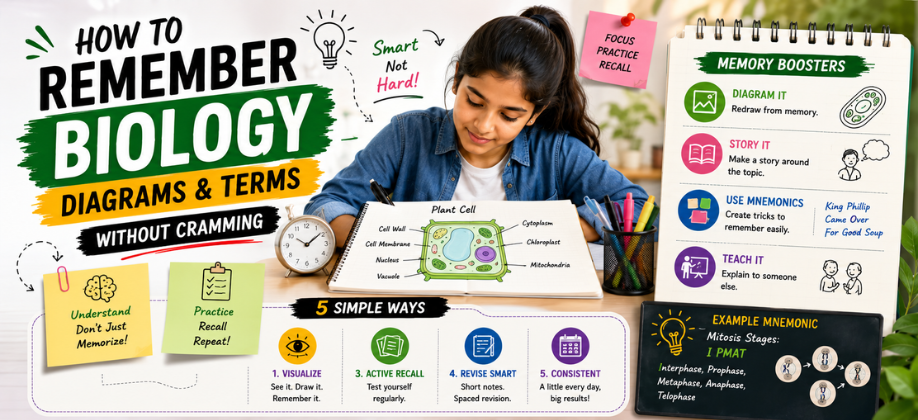
Visual thinkers take to this fast. It works for the same reason drawing helps with remembering biology diagrams and terms: your hand remembers what your eyes skim over.
Getting IUPAC naming right the first time
IUPAC naming carries the cheapest marks in the unit, and students give them away every year. Fix it with ten minutes a day for two weeks: five structures to name, five names to draw. Practise both directions, because papers ask both and drawing a structure from a name is the harder half.
- Identify the principal functional group first. Seniority runs acid, ester, amide, nitrile, aldehyde, ketone, alcohol, amine.
- Pick the longest chain that contains that group. Longest chain alone is not the rule, and that is where most errors start.
- Number from the end that gives the principal group the lowest number.
- Name substituents alphabetically, and ignore di, tri and tetra when alphabetising.
- Read your finished name back and draw it. If you get the original structure, you are done.
The four traps that eat marks
Numbering from the wrong end, missing a branch on a chain drawn at an angle, assuming the main chain is the horizontal one on the page, and writing di-methyl instead of dimethyl. Keep a page at the back of your notebook and log every naming error. Most students repeat only three or four.
How do you solve conversion questions?
Work backwards. Look at the target molecule, ask which single reaction produces that functional group, and write that last step first. Then ask what starting material the step would need, and keep stepping back until you reach the compound the question gave you. Guessing forward wastes time.
A worked example
Convert propan-1-ol into propan-2-ol.
- The target is a secondary alcohol. Adding water to propene follows Markovnikov's rule and puts the OH on the middle carbon, so that is the final step.
- The step before must produce propene. Heating propan-1-ol with concentrated sulphuric acid at about 443 K does exactly that.
- Two steps, and you never had to store this conversion as a fact.
Keep one short list of reactions that change the number of carbons, since conversions hinge on these. To add a carbon: a haloalkane with KCN followed by hydrolysis, or a Grignard reagent with carbon dioxide. To remove one: decarboxylation with soda lime, or the Hofmann bromamide reaction on an amide.
A weekly practice plan for Classes 11 and 12
Give organic chemistry about three and a half hours a week, broken into short sessions rather than one long Sunday sitting. Split it by skill: mechanisms one day, naming another, conversions another, and one mixed timed set at the weekend. The mixed set matters most, because a real paper never tells you which chapter a question came from.
| Day | Time | What you do |
|---|---|---|
| Monday | 30 minutes | Redraw two mechanisms from memory, then check against the book |
| Wednesday | 30 minutes | Ten IUPAC items, five to name and five to draw |
| Thursday | 30 minutes | Five conversions, each solved backwards from the target |
| Saturday | 60 minutes | Build or rebuild the map for the chapter in progress |
| Sunday | 45 minutes | Fifteen mixed questions from past papers, timer running |
Class 11 students should put most of that time into general organic chemistry and hydrocarbons, since the electron ideas learned there carry all of Class 12. Class 12 students cover heavier ground, so the Saturday session often needs to become two.
Fit this inside a wider plan rather than treating it as extra load. Our six-month board exam timetable shows one way to divide a week, and using sample papers properly matters more than collecting twenty of them.
An honest warning about this plan
Three and a half hours a week will not rescue a student who is four chapters behind with two weeks to go. In that case drop the map building and spend every session on past paper questions from the highest-weightage chapters. Check the official CBSE or ICSE website for the current year's marking scheme first.
Mistakes that cost marks in the board exam
Most lost marks in organic chemistry are not caused by ignorance. They come from missing conditions, wrong numbering, skipped intermediates and unbalanced equations. Examiners award marks step by step, so a mechanism with correct arrows and one small slip still scores, while a bare product with no working often scores nothing.
- Writing the reagent above the arrow but leaving out the temperature or solvent. Concentrated sulphuric acid without 443 K can cost half a mark.
- Jumping straight from reactant to product and skipping the carbocation or tetrahedral intermediate that carries the marks.
- Mixing up Markovnikov and anti-Markovnikov addition. The peroxide effect applies to HBr only, not HCl or HI.
- Naming with all the right substituents but numbering the chain from the wrong end.
- Leaving equations unbalanced, especially in oxidation questions where water quietly goes missing.
All of these are catchable well before February if a student marks their own paper strictly. Our piece on how to stop making silly mistakes in exams covers the checking habits worth building now.
If a student has genuinely lost the thread, a group class rarely repairs it, because the exact point where the reasoning broke is personal. Dheeru Home Tuitions runs one-on-one chemistry tuition for Classes 11 and 12 across Gurugram, including Sushant Lok and Sohna Road.
What to do this week
Apply all of this to one chapter, not to the whole book. Five days is enough to see whether the method suits you, and it costs you nothing if it does not. Pick the chapter your school is teaching right now, so the work counts twice.
- Copy the functional group table onto the inside cover of your organic notebook.
- Build one reaction map for your current chapter, red ink for everything you missed.
- Redraw two mechanisms from memory on blank paper, with no peeking until you finish.
- Do ten IUPAC items, five each way, and log every error at the back of the notebook.
- Solve five conversions backwards, writing one line of reasoning beside each step.
- On Sunday, take fifteen mixed questions with a timer and mark them yourself.
Then ask one honest question at the end of the week. Did an unfamiliar reaction feel less frightening than it did on Monday? That small shift usually shows up before the marks do.