Every year around September, a Class 10 parent in Gurugram sends the same message. The child sailed through Class 9 without much help. The first unit test of Class 10 comes back at 61 per cent. Nothing changed at home, but the marks changed anyway.
Class 10 is not dramatically harder than Class 9. What changes is that everything counts, the syllabus is longer, and there is no comfortable space left to postpone a chapter to "later".
Here is a subject by subject walk through the year: what your child is studying, where the marks sit, where students lose them, and how to spread the work so February is not a panic.
What subjects does a CBSE Class 10 student take?
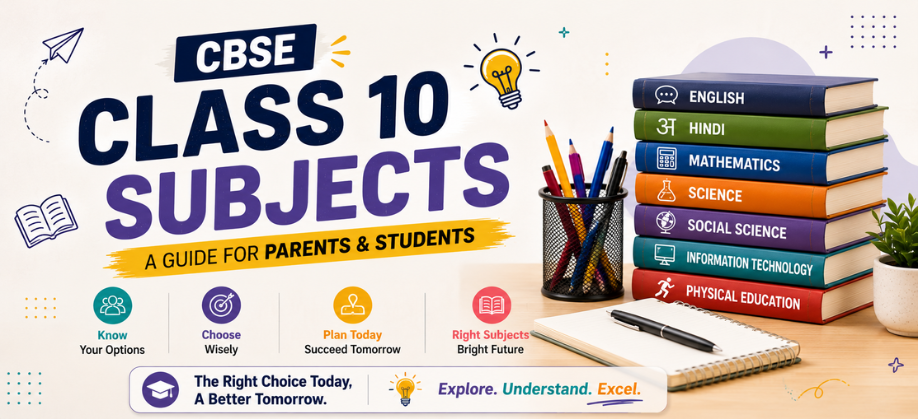
Most CBSE Class 10 students take five main subjects plus a sixth. The usual set is English, a second language such as Hindi, Sanskrit or French, Mathematics, Science and Social Science. Schools add a skill subject as the sixth, and Mathematics is offered at two levels, Standard and Basic.
The sixth subject matters more than parents realise. If your child scores poorly in one main subject, the school can often use the sixth subject marks in its place. Ask your class teacher how your school handles this, because practice varies.
| Subject | Usual shape of the assessment | Heaviest part of the year | Where marks are commonly lost |
|---|---|---|---|
| English | One written paper plus school internal work | Literature and writing formats | Long literature answers with no textual reference |
| Hindi / Sanskrit / French | One written paper plus internal work | Grammar and prescribed prose | Vyakaran rules left for the last month |
| Mathematics | One written paper plus internal work | Algebra and Geometry | Steps skipped, so method marks disappear |
| Science | Written paper plus a practical or internal component | Physics numericals, Chemistry equations | Unbalanced equations, missing units, weak diagrams |
| Social Science | Written paper plus internal work, including map work | Four books read at once | Reading without recall practice, ignoring maps |
| Skill subject (sixth) | Theory plus a practical or project | Project submission window | Treated as unimportant until the deadline |
Paper patterns and unit weightings are revised from time to time. Download the current year's syllabus from the official CBSE academic website in April, rather than trusting a senior's notes from two years ago.
How do internal assessment marks work?
In most subjects, the final 100 marks split into a written board paper and internal assessment handled entirely by the school. Internal assessment is usually worth 20 marks and is built from periodic tests, notebook submission, subject enrichment work such as practicals or a listening and speaking task, and the school's own assessments. Once uploaded, these marks cannot be revised.
These are the calmest marks of the year. They are earned in ordinary weeks, with no exam pressure. Yet families usually ignore them until the December report card.
- Periodic tests: Small chapter tests through the term. Missing one because of a family trip usually means a zero, not a re-test.
- Notebook: Complete work, dated, corrections done. A child who copies three chapters the night before submission loses marks that were free.
- Subject enrichment: Science practicals, the English listening and speaking task, Maths lab work, Social Science project. Each has a fixed submission window.
- Multiple assessment: Class quizzes, oral questions, group work. Attendance and participation quietly feed into this.
Check the notebook once a month, not once a term
Pick a Sunday and flip through every subject notebook for ten minutes. You are looking for blank pages, missing dates and uncorrected work, not for handwriting quality. Fixing two missing chapters in August costs one evening; fixing them in December is not possible.
Which Maths chapters carry the most weight?
Algebra and Geometry together usually make up the largest share of the Class 10 Maths paper. Trigonometry, Mensuration, Statistics and Probability, Coordinate Geometry and Number Systems fill the rest. Exact unit-wise marks are revised periodically, so confirm the current split from the official syllabus before building a study plan around it.
Standard or Basic?
Standard Maths keeps the door open for Maths in Class 11. Basic is a genuine option for a child heading towards Humanities or most Commerce combinations. Schools apply their own cut-off rules, so ask early.
Be honest here. Choosing Standard to protect a child's pride, when the child is scoring 40 per cent in Class 9 Algebra, mostly buys a difficult Class 11. Choosing Basic when the child actually enjoys Maths closes doors early.
Where Class 10 Maths goes wrong
- Quadratic equations and arithmetic progressions: are usually fine in class and fall apart in word problems. The gap is translation, not algebra.
- Triangles and circles: need theorem proofs written properly. Many students know the idea and lose marks on construction lines and "given, to prove, proof" structure.
- Trigonometry identities: reward practice volume more than cleverness. Twenty solved identities in a week changes a child's speed noticeably.
- Surface area and volume: questions are lost to calculation slips, not concept gaps.
The fix is boring and it works: solve without looking at the solved example first. If your child reads a worked solution and then does a similar sum, that is copying, not practice. A few more everyday habits that improve Maths marks are worth building from April.
Where students lose marks in Science
Science is one paper covering Physics, Chemistry and Biology, with a practical or internal component alongside. Marks slip in three predictable places: Physics numericals attempted without writing the formula, chemical equations left unbalanced or without conditions, and Biology answers that name a process but never explain it. Diagrams are the cheapest marks in the paper.
Physics
Light, electricity and magnetic effects carry real weight and all three involve numericals. Ask your child to write the formula, then the substitution, then the answer with units, on three separate lines. Examiners give step marks. A single-line answer that is wrong earns nothing. Students who freeze on these questions usually benefit from a fixed method for approaching numericals calmly.
Chemistry
Chemical reactions, acids and bases, metals and non-metals, and carbon compounds are the backbone. Balancing equations and naming organic compounds are worth drilling weekly. Ten minutes every Saturday from May onwards is enough.
Biology
Life processes, control and coordination, reproduction and heredity carry the load. Biology rewards clean, labelled diagrams and correct terms. Meera, a student in Sushant Lok, moved from 68 to 82 in Science mostly by redrawing eight diagrams from memory every Sunday.
A neat labelled diagram earns marks even when the words around it are only average.
Handling the Social Science reading load
Social Science means four separate books, History, Geography, Political Science and Economics, plus map work. It is the heaviest reading of the year and the subject students most often leave for the end. The way through is not more reading. It is turning each chapter into a one-page point sheet and then testing recall without the book open.
- History: needs cause and effect, not date lists. Ask your child to explain a chapter in five sentences before writing anything down.
- Geography: is the most scoring of the four because much of it is factual and map-based.
- Political Science: answers improve fast when examples are added. One real example per answer is usually enough.
- Economics: is short but definition-heavy. Keep a running list of terms with a one-line meaning each.
Map work deserves special attention. It is a fixed, finite list of locations that can be finished in a few sessions. Students who practise blank outline maps once a fortnight rarely lose those marks. For the rest, some memory techniques for dates and facts save hours of rereading.
What the English and second language papers actually test
The English paper tests three things: reading comprehension of unseen passages, writing in fixed formats such as letters and analytical paragraphs, and literature from the prescribed books, with grammar spread across the paper. Literature carries the biggest share. The second language, whether Hindi, Sanskrit or French, follows a similar shape.
Reading and grammar sections are where careful students quietly gain. They need no memorising, only practice under time. Literature is where marks are lost, usually because answers stay general and never quote or refer to the text.
Teach one habit: every long literature answer should mention a specific incident or line from the chapter. That single change lifts most answers by a mark or two, and structuring literature answers properly is a skill worth fixing early in the year, not in January.
Do not leave writing formats to the last week
Letters, notices and analytical paragraphs each have a fixed layout. Get your child to write one of each in August, have it corrected, and keep those pages as the model for the year. Format marks are given for structure, not for beautiful ideas.
Planning the year from April to March
Split the session into three blocks. April to September is first-pass learning, plus every internal assessment mark you can secure. October to December is finishing the syllabus and completing one full revision. January to February is sample papers and a second revision, leaving the final weeks for recall only. Never plan a first revision for January.
- April to June: Build the routine. Two hours on weekdays is plenty, if it is genuinely two hours. Keep Social Science moving alongside Maths and Science.
- July to September: The heaviest teaching months. Protect periodic tests and notebook deadlines. Identify the two weakest chapters per subject now, not in December.
- October to December: Syllabus completion and first full revision. Start solving previous years' questions chapter by chapter.
- January to February: Full sample papers under exam timing. Analyse each paper for the type of error, not just the score.
Sample papers only help if they are marked honestly and the mistakes are logged. A detailed method for using sample papers the right way is worth reading before January, and a full six-month board exam timetable helps if your child is already behind.
If you are considering outside help, decide by September
Starting a tutor in December means firefighting, not teaching. Most families in Gurugram pay somewhere between Rs 8,000 and Rs 18,000 a month for one-on-one Class 10 support, depending on subjects and the tutor's experience. Our board-wise learning programs page explains how one-on-one, small group and hybrid formats differ.
What to do this week
Three actions, all doable in seven days. Download the current CBSE Class 10 syllabus document from the official board website. Ask the school in writing for the internal assessment breakdown in each subject. Then have your child attempt one full Maths paper under proper timing to see the real starting point, not the assumed one.
- Sit with your child and list the five chapters they least want to open. That list is the actual study plan for the next month.
- Fix one weekly slot for Social Science, even if exams are far away. Twenty minutes on a Wednesday beats twelve hours in January.
- Check whether the school has confirmed the sixth subject and its project deadlines.
- Decide roughly, not finally, whether Standard or Basic Maths fits, and revisit it after the half-yearly result.
One last thing. The Class 10 result shapes which stream a school will offer in Class 11, so read about how to pick a stream after Class 10 before the marks arrive. A calm year beats a heroic March, every single time.