It is 9:40 on a Tuesday night in Sushant Lok. Your Class 7 daughter has been sitting with the same maths worksheet since dinner. Three sums done, seven left, handwriting falling apart line by line.
You lean over her shoulder. You can see exactly where she went wrong. In ninety seconds you could fix it and everybody could sleep.
Those ninety seconds are the whole problem. Here is what to do instead, and how to spot the moment when helping turns into doing the homework yourself.
What does good homework help actually look like?
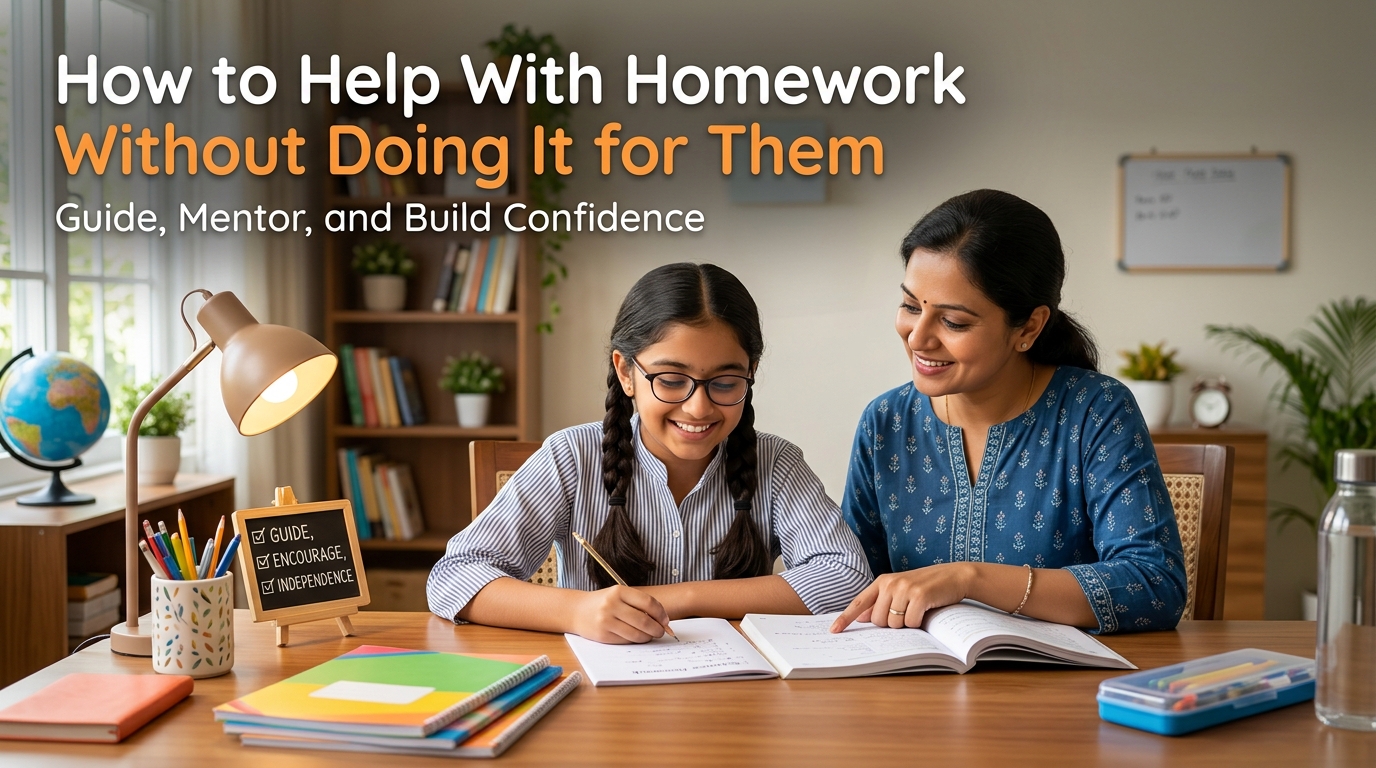
Good homework help means you set up the conditions and ask questions, not supply answers. You keep the room quiet, check what is due, and stay close enough to hear. Your child holds the pencil the whole time. The goal is your child working alone for longer each month, not a finished notebook by 10 pm.
A child who gets rescued every night never builds the one skill that decides board exam marks: staying calm while stuck. In February, nobody sits next to them.
Think of your role as three jobs, and only three:
- Getting the work started: Fixing the time, clearing the table, putting the phone in another room. Starting is the hardest part, and the part you can control.
- Keeping the space workable: Enough light, a chair that is not the sofa, no television in the background. Our guide on setting up a study space at home covers this even for small flats.
- Checking effort, not correctness: Ask if every question was attempted. Do not mark the answers. The teacher needs the real picture.
Where is the line between helping and doing it for them?
The test is simple. If your child could not explain the answer to a classmate tomorrow morning, you helped too much. Support means narrowing the problem, pointing to the right page, or reading the question aloud. Rescue means supplying the steps, the sentence, or the final number.
| What you do | What your child takes away | Verdict |
|---|---|---|
| Read the question aloud and ask what it is asking for | How to break a question into parts | Support |
| Point to the page in the textbook where the rule is printed | Where to look next time without asking | Support |
| Dictate the opening sentence of the English essay | That somebody else starts hard things | Rescue |
| Solve one sum on rough paper for them to copy exactly | Pattern copying, which fails when numbers change | Rescue |
| Type the project on your laptop at 11 pm | That deadlines are the parent's problem | Rescue |
The two-minute rule
If your child has been stuck for less than two minutes, do nothing. Most parents step in at around twenty seconds of silence. Sit still, keep your face neutral, and let the discomfort sit there. Plenty of problems solve themselves in the third minute.
How to ask questions instead of giving answers
Replace every answer you want to give with a question that sends your child back to their own book. Keep the questions short and always the same, so they become a habit. "What is the question asking for?" "Which chapter is this from?" "Show me the first step you tried." Then stop talking and wait.
The waiting matters more than the wording. Count ten seconds before saying anything else.
Questions that work in almost any subject
- "Read the question out loud, slowly." Many wrong answers in Class 6 to Class 10 come from misreading, not from not knowing.
- "What do you know, and what must you find?" Ask your child to write both lists in the margin first.
- "Show me the last line you were sure about."
- "If you had to guess right now, what would you guess?" A guess is easier to correct than a blank page.
Questions for maths and science
- "What units should the answer be in?" This catches many physics errors early.
- "Does that look sensible? Can a triangle have a side of minus four?"
- "Try easier numbers first. What if the speed were 10 instead of 37.5?"
If your child cannot answer even the first question, that is useful information. It usually means the concept was never understood in class. Students who freeze on every sum may be dealing with maths anxiety.
Sitting nearby instead of hovering over them
Sit in the same room but not at the same table. About three to four feet away, side on, doing your own quiet work. Close enough that your child can call you, far enough that you cannot read the notebook. Hovering over the page makes most children slower and more anxious.
In a 2BHK or a busy joint family flat, that is not always possible. Three workable versions:
- Sit at the dining table with your laptop while your child works at the far end, facing away.
- Take the sofa with a book. Phone face down, on silent.
- For Class 11 and 12, leave the room and check in once an hour.
Set an interruption rule first: finish the question you are on, then bring every doubt together. This stops the child who calls you after every line.
Batch the doubts
Give your child a slip of paper and ask them to write each doubt down instead of shouting it out. After forty minutes, go through the list. Many doubts solve themselves before you reach them.
Should you let your child submit a wrong answer?
Yes, most of the time. A wrong answer your child produced tells the teacher exactly what needs reteaching. A perfect answer produced by you tells the teacher nothing, and the gap shows up later in a test. Let imperfect work go on ordinary days, and save your worry for graded projects.
A notebook full of your handwriting buys one peaceful evening and costs your child a whole chapter.
There are exceptions. If a project carries real internal assessment weight, or your child is ill and behind, help openly and say so. Honest support is not silent rescue.
When the notebook comes back with red marks, sort the mistakes with your child into three piles: did not know it, knew it but slipped, did not read the question. Only the first pile needs teaching.
How to handle a homework meltdown
Stop the homework, not the child. When tears or shouting start, no learning is happening, so continuing is pointless. Say one calm line, offer a ten-minute break away from the desk, and do not argue about the maths during the break. Come back only when breathing has settled, and restart on an easier question.
A sequence that works for most families:
- Name it without judging: "This one is frustrating. Let us stop for ten minutes." No lecture, no comparisons.
- Move the body: Water, the balcony, something to eat. Most 9 pm meltdowns in Class 5 to Class 8 are really hunger and tiredness wearing a maths costume.
- Restart lower: Go back to a question they already solved correctly. Getting one right resets confidence faster than any pep talk.
- Draw a line: If nothing is working, write an honest note in the diary. Sleep beats three unsolved sums.
If meltdowns happen three or four nights a week, homework is not the real issue. Look at sleep timing, screen habits and how far behind your child feels in class. Our article on motivating a child who does not want to study goes deeper, and managing exam stress helps in February and March.
How long should homework take each night?
As a rough guide, expect ten to fifteen minutes per class level per night, spread across all subjects. A Class 5 child might spend under an hour, and a Class 9 student around ninety minutes. Board exam years run longer. If your child regularly needs double this, something is wrong.
| Class | Typical total homework time | How involved you should be |
|---|---|---|
| Classes 1 to 3 | 20 to 30 minutes | In the room, reading instructions aloud |
| Classes 4 to 6 | 40 to 60 minutes | Nearby, asking questions, not marking |
| Classes 7 to 8 | 60 to 90 minutes | On call, doubts batched at the end |
| Classes 9 to 10 | 90 minutes to 2 hours | Out of the room, weekly review |
| Classes 11 to 12 | 2 hours and above | Logistics and calm only |
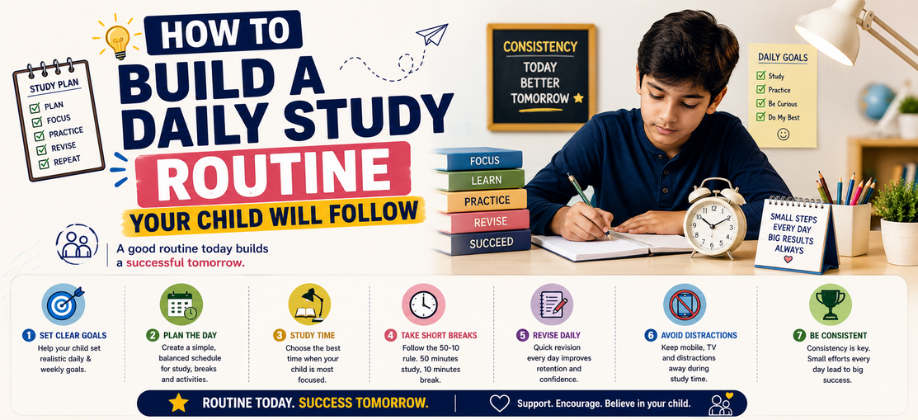
These are guides, not rules. Loads vary a lot between CBSE, ICSE, IB and IGCSE schools, and IB students carry longer written tasks. If your child takes far longer than the table suggests, the usual causes are a slow start, phone distraction, or a gap from an earlier class. A steady daily study routine fixes the first two.
When should you stop helping and call a tutor?
Call for outside help when the same topic keeps failing after two or three honest attempts, when the subject is past your own comfort level, or when homework has become the main source of conflict at home. A tutor is not an admission of failure. It protects the learning and your relationship with your child.
Concrete signals that the DIY stage is over:
- You have explained the same concept three times and it still does not hold by the next evening.
- Your child hides the diary or says the teacher gave nothing, week after week.
- You last studied the subject twenty years ago, or it is taught differently now.
- Every session ends in shouting, and you can no longer sit together calmly.
- Marks have slipped across two tests in a row in one subject.
Our list of signs a child needs a home tutor also names three situations where a tutor is the wrong answer. Fees in Gurugram vary with class, board and group size. Most families pay a few thousand rupees a month for junior classes, and noticeably more for Class 12 science or IB subjects. The learning models and how fees are worked out sit on our programs page.
Ask the tutor to teach you too
In the first month, sit in for ten minutes and watch how the tutor handles a stuck moment. Copy those exact questions. Parents who do this find their own evening sessions get shorter and calmer.
At Dheeru Home Tuitions we suggest a free demo class first, so your child meets the teacher before you commit. You can book one through the contact page or on WhatsApp.
What to do this week
Pick two changes, not ten. Fix a homework start time and hold it for seven days, and replace your first answer each evening with a question. Write down how long homework actually took each night. After a week you will have real information instead of a feeling.
- Monday: Agree a start time and stick it on a note near the study table. Same time daily, including Friday.
- Tuesday: Move your chair three feet away and bring your own work.
- Wednesday: Use only the three standard questions. About to give an answer? Drink water instead.
- Thursday: Let one imperfect answer go to school untouched. Notice what happens next day, usually nothing.
- Friday: Read your week of timings. Any subject eating double the time it should is your candidate for extra help.
None of this makes homework enjoyable. It will not. It shifts the effort back where it belongs, so that by Class 10 your child can sit alone, get stuck, and keep going anyway.