Diya is in Class 4. Read her a chapter aloud and she can retell the whole thing an hour later, names in the right order, with a joke of her own added. Ask her to read that same page herself and she stops in the third line.
Her spelling notebook is full of red. "Was" comes out as "saw". The letters b and d keep swapping. Her school diary in South City now carries the word "careless" almost every week.
Her parents can see she is not careless. She listens well, argues brilliantly, remembers what she hears. Something about print is not clicking.
What is dyslexia, and what is it not?
Dyslexia is a lifelong difference in how the brain connects letters to sounds. It makes reading, spelling and writing slow and tiring, even when a child has normal intelligence, decent teaching and is genuinely trying. It is not a disease, not an eyesight problem, and not a phase children grow out of.
Reading is not natural for any brain. Every child has to be taught that "sh" makes one sound. For most, that link forms quickly and then runs on its own. For a child with dyslexia it stays slow and costs effort every time.
Three myths worth dropping
- "She just sees letters backwards." Reversing b and d is common in early classes. The real marker is difficulty breaking words into sounds.
- "He will catch up next year." Without direct teaching of sounds and spelling the gap widens, because the reading load rises every class.
- "It is the screens." Screens affect sleep and attention, as our piece on screen time and studies covers. They do not cause dyslexia.
Early signs of dyslexia by age
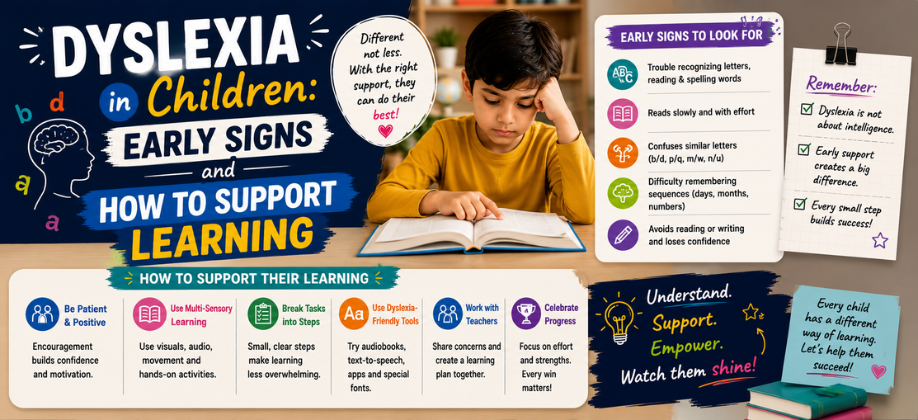
The signs change as a child grows. Before school they show up in speech, rhyming and learning letter names. In Classes 1 to 3, in slow effortful reading and unstable spelling. From Class 4 onwards, in avoidance, tiredness, and a widening gap between what your child says aloud and what they write down.
| Stage | Signs parents notice | Usually not a worry |
|---|---|---|
| Age 4 to 5 | Struggles with rhymes, muddles words like "hopsital", cannot recall letter names | Slow interest in books |
| Classes 1 to 3 | Guesses words from the first letter, reads a word right on one line and wrong on the next | Reversing b, d, p and q; untidy handwriting |
| Classes 4 to 6 | Avoids reading aloud, loses the meaning by the end of a paragraph, takes twice as long over homework | Disliking one boring chapter |
| Classes 7 to 10 | Oral answers far stronger than written ones, weak spelling in every subject | Rushed answers when unprepared |
One sign alone means very little. Look for a cluster that has lasted six months and shows up at school as well as at home. Ask quietly whether an uncle or grandparent also hated reading.
Listen to reading, do not just check the marks
Have your child read an unseen page aloud from a book one class below their level. Count how often they stop, guess or reread a line. Ten minutes of this tells you more than a term's report card.
Does dyslexia mean my child is less intelligent?
No. Dyslexia sits in one narrow area, the link between letters and sounds. Reasoning, memory for ideas, spatial thinking, humour, maths problem solving and practical skill are all untouched. Many children with dyslexia give excellent oral answers. The reading difficulty hides their ability from teachers rather than showing any lack of it.
Say this to your child directly. Children who are told nothing invent a worse explanation. By Class 5 most have decided they are the slow one in the class, and that belief does more lasting damage than the spelling ever will.
A child with dyslexia is not reading badly because they tried less, they are reading badly while trying much harder than anyone else in the room.
What else could look like dyslexia?
Several ordinary things produce the same report card. Weak eyesight, mild hearing loss after repeated ear infections, a change of school or board, missed early teaching, anxiety, or plain difficulty with attention. Rule these out first. Two of them are settled by a simple test and are far more common.
- Vision and hearing: Check both first. A child who cannot hear the difference between "pin" and "pen" spells badly for an ordinary reason.
- Attention: If your child reads fine but finishes nothing, start with our guide to study strategies for children who cannot focus.
- Gaps in teaching: A child who moved boards may have missed the phonics stage, as our article on changing boards mid-year explains.
- Pace, not print: Some children learn everything slowly but steadily, as our piece on what "slow learner" really means describes.
How do you get a child assessed for dyslexia in India?
Start with your school counsellor or paediatrician, then ask for a referral to a clinical psychologist or special educator qualified to test for specific learning disabilities. A proper assessment takes two or three sittings and covers reading speed, spelling, comprehension, memory and reasoning. Most families in Delhi NCR pay somewhere between Rs 5,000 and Rs 15,000.
Do not accept a diagnosis from an online quiz, an app, or a tutor who spent an hour with your child. Ask which tests were used, and ask for the report in writing. Schools and boards will want to see it.
What a useful report contains
- The tests used and your child's actual scores, not just a label at the bottom of the page.
- A clear list of strengths, since the teaching gets built on those.
- Named recommendations: extra time, a reader, a scribe, spelling not penalised in content subjects.
- A review date, usually a year or two later, as needs change with the reading load.
What accommodations do Indian schools and boards allow?
Every major board in India has provisions for students with an assessed specific learning disability. Typical support includes extra time in exams, a reader or scribe, exemption from a third language, use of a calculator, and marking that ignores spelling outside language papers. Rules and paperwork change yearly, so confirm on the official board website.
The Rights of Persons with Disabilities Act, 2016 recognises specific learning disabilities, which is what makes these arrangements possible. Schools cannot refuse to discuss them. They need a valid report and an application well before the exam session.
| Board | Support commonly available | What parents do |
|---|---|---|
| CBSE | Extra time, scribe or reader, calculator, language exemptions | Apply through the school, well before the exam year |
| ICSE and ISC | Extra time, scribe, language exemption, spelling leniency | School forwards the case with documents |
| IB | Access arrangements including extra time, word processor | Report must be recent; coordinator files it |
| IGCSE | Extra time, readers, separate rooms | Evidence of normal classroom practice |
| NIOS | Flexible subjects, spread out exams | Worth considering for older students |
Talking to the school
- Ask for a meeting with the counsellor and class teacher together, not a two-minute comment at the parent-teacher meeting.
- Carry a sample of your child's written work beside an oral answer you wrote down for them. The contrast argues better than you can.
- Ask for two or three specific things, such as no reading aloud in class. Our list of questions to ask at a parent-teacher meeting helps here.
Older students who have fallen far behind sometimes do better with a lighter structure. Our guide to NIOS admission explains who it suits, and it is no soft option.
Home strategies that help with reading and spelling
Short, daily and specific beats long and occasional. Fifteen focused minutes every day does more for a struggling reader than an hour on Sunday. Work on sounds directly, reread the same passage across the week to build fluency, and separate thinking from writing so your child can still show what they know.
For reading
- Take one short paragraph and read it three times across the week. The third reading feels fluent, and that feeling rebuilds confidence.
- Read alternate lines, you then your child, so the sentence does not collapse.
- Play sound games with no book: what is "cat" without the "c", what rhymes with "beat". This is the exact skill that is weak.
- Use audiobooks for story and vocabulary, printed practice for decoding.
For spelling and writing
- Teach patterns, not lists. Ten words that all use "ight" stick better than twenty unrelated ones.
- Let your child say the answer aloud while you note the key points, then have them copy. Ideas and handwriting compete for the same energy.
- Mark content and spelling separately. Two ticks for the idea, one correction, not a page of red.
Writing improves slowly, and structure helps more than vocabulary drills. Our guide on improving English writing at home has exercises you can shorten for a child who tires quickly. Keep your own role to sitting nearby and asking questions, as our piece on helping with homework without doing it explains.
Keep reading aloud, whatever their class
Read them books well above their own reading level, even in Class 8 or 9. It keeps vocabulary and ideas growing while decoding catches up separately. Ten minutes at night is enough, and most children who resist soon start asking for it.
Does a home tutor help a child with dyslexia?
A tutor helps if they teach reading directly, using structured sound-based methods, and are patient enough to repeat one pattern for weeks. A tutor who only revises the school chapter will not change much. One-on-one matters more here than in most subjects, because the work must sit exactly at your child's level.
Ask what they will do in the first month, and listen for specifics: sounds, syllables, spelling patterns. Vague answers about confidence are a warning sign. In Gurugram, tutors with special education training usually charge somewhere between Rs 8,000 and Rs 20,000 a month, and honest ones will say progress is measured in months.
Dheeru Home Tuitions offers special education support alongside regular subjects, and a free demo class is the cheapest way to see whether a tutor suits your child.
Do not wait for the report to start
Assessment waiting lists can run into months, and good teaching need not wait for paperwork. Begin the daily reading and spelling work now. If it turns out not to be dyslexia you have lost nothing, since that practice helps every struggling reader.
What to do this month
Pick three of the steps below and give them four weeks before you judge anything. Trying all six at once is how families burn out by the second Sunday, and a child who senses panic at home reads even worse than before. Slow and boring wins here.
- Book an eye test and a hearing test this week. Both rule out simpler explanations.
- Sit through ten minutes of your child reading an unseen page aloud, and note what you see.
- Ask the school counsellor whether they assess, or whom they refer families to.
- Start fifteen minutes of daily reading, repeating one short passage across the week.
- Tell your child plainly that their brain handles print differently, and it says nothing about how clever they are.
- Stop correcting every spelling mistake. Choose one pattern a week.
Progress here is slow and uneven, and some weeks look like going backwards. What shifts first is not the spelling but the willingness to try. That alone is worth the month.