A Class 11 student in South City reads the chapter on laws of motion twice. She can explain Newton's third law to her younger brother without opening the book. Then the unit test arrives, question three has a block sliding down an incline, and her answer sheet stays blank for four minutes.
Almost every Gurugram home with a science student sees some version of this. The theory is understood. The numerical still refuses to start. The gap is not knowledge. It is method.
Below is a repeatable way to start any numerical, the mistakes that cost most marks in mechanics, electricity and optics, and a practice plan for Classes 9 to 12.
Why do physics numericals feel harder than theory?
Numericals feel harder because theory asks you to recall while numericals ask you to decide. In one question you must picture the situation, choose one relation out of thirty, track units, and do the algebra. Most students only practise the algebra, which was never the difficult part.
There is a second reason, and it is emotional. A blank page creates panic within seconds, and panic makes you grab the first formula you remember. That is how a student who knows the chapter ends up using v = u + at on a work and energy question.
Panic is a timing problem, not a talent problem
Most students freeze in the first minute, before anything is written. Make a rule: the first thing on the page is always a diagram, never a formula. A sketch takes twenty seconds and buys your brain time to recognise the situation.
A six-step method that works on any numerical
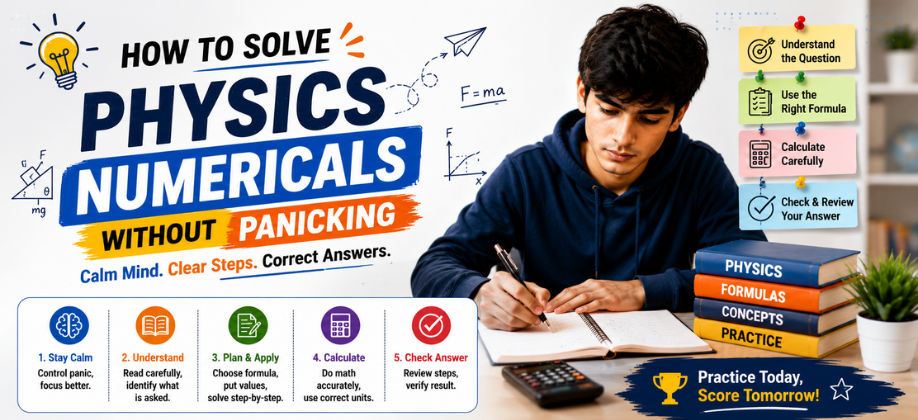
Use the same six steps every time: read and draw, list what is given and asked, choose the relation that connects them, convert to SI units, estimate a rough answer, then solve and check. A fixed order removes the decision about where to start, and that decision is where most time is lost.
- Read twice and draw: The first reading tells you the topic, the second gives you the details. Draw the block, circuit, ray or pulley.
- List given and required: Write the symbols in a column: u = 5 m/s, t = 3 s, a = ? Seeing them stacked often shows you the formula straight away.
- Pick the relation: Ask which equation contains both what you have and what you want. If none does, the question needs a middle step.
- Fix the units: Change grams to kilograms and minutes to seconds before you substitute anything.
- Estimate first: Round the numbers and get a rough answer in your head. A car braking from 20 m/s will not stop in 0.02 metres.
- Solve and check: Calculate, write the unit, then ask whether the size and the sign make sense.
Reading the question and drawing the diagram
Draw before you write a single number. A rough sketch turns a paragraph of English into physics you can see: which way forces point, where the object starts, which surface it touches. Label the known values on the drawing. Students who draw make far fewer sign errors, because direction becomes visible instead of imagined.
What a useful diagram contains
- Every force as a named arrow: weight, normal reaction, friction, tension. A free body diagram beats any formula sheet.
- One direction chosen as positive. Half the sign errors in kinematics come from never deciding this.
- The known values written on the figure, and the quantity asked for circled with a question mark.
For circuits, redraw the circuit neatly instead of working off the printed one. Mark which resistors share the same two junctions. That is the only reliable way to see series and parallel.
How do you choose the right formula?
Choose by matching quantities, not by remembering which chapter the question came from. Look at your given list and your required quantity, then find the relation that contains both. If nothing contains both, you need an intermediate quantity and the question is a two-step problem. This one skill separates a 65 from an 85.
Keep one page per chapter with formulas grouped by what they connect, not by textbook order. Then learn the clue words. Board questions reuse the same phrasing year after year.
| Phrase in the question | Topic | Relation to try first |
|---|---|---|
| "smooth incline, find the acceleration" | Newton's laws | Resolve weight along and across the incline |
| "how far before it stops" | Kinematics or energy | v squared = u squared + 2as, or work-energy |
| "current through the 6 ohm resistor" | Current electricity | Equivalent resistance, then Ohm's law backwards |
| "image is real and inverted" | Ray optics | Mirror or lens formula, sign convention first |
| "heat produced in 5 minutes" | Heating effect of current | H = I squared R t, with t in seconds |
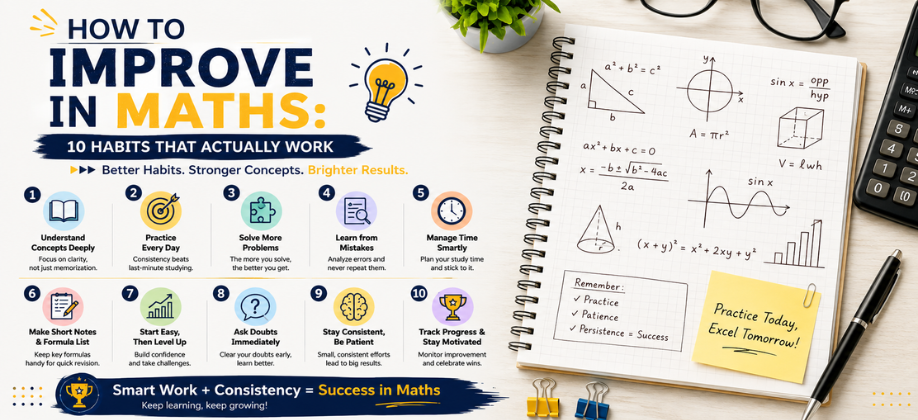
If two chapters could both apply, pick the one with fewer unknowns. Energy methods usually beat force methods when the question says nothing about time. This is the same habit that raises maths marks, so our guide on better maths habits transfers directly.
Checking units and estimating before you solve
Convert every quantity to SI units before substituting, then estimate the answer roughly in your head. Units catch mistakes algebra cannot. If your force answer comes out in kilogram metres, you have dropped a second. Estimating catches the other error, where the method is right and the calculator is wrong.
A wrong number with the right unit is a slip, but a wrong unit means the physics itself went off track.
The costly conversions are predictable:
- Mass in grams. A 500 g block is 0.5 kg, and missing this makes your force answer a thousand times too big.
- Distance in centimetres in optics. You may work fully in centimetres, as long as you never mix the two.
- Time in minutes in electricity questions. Five minutes is 300 seconds, not 5.
Use g = 10 for the estimate, 9.8 for the answer
Round hard while estimating. Take g as 10, pi as 3, drop the decimals. If your rough answer is 45 and the calculator says 4.5, you have made a power-of-ten slip and thirty seconds to find it.
Common mistakes in mechanics, electricity and optics
The mistakes repeat, and there are not many of them. In mechanics students forget to resolve forces and lose signs. In electricity they misread series and parallel, or find total current when one branch was asked. In optics they abandon the sign convention halfway. Fixing these three families removes most lost marks.
Mechanics
- Using a kinematic equation when the acceleration is not constant. Those equations only hold while a stays the same.
- Treating friction as always opposing motion. Static friction simply balances the applied force, up to a limit.
- Forgetting that weight acts straight down even on a slope, so it must be split into two parts first.
Electricity
- Calling two resistors parallel because they look parallel. They are parallel only if both ends meet the same two junctions.
- Using V = IR with a voltage from one part of the circuit and a resistance from another.
- Ignoring the internal resistance of the cell when the question gives it, or writing the answer with no unit.
Optics
- Switching sign convention halfway, usually between the mirror formula and the magnification formula.
- Treating a concave mirror and a concave lens as the same thing. One converges light, the other spreads it.
- Not checking the answer against the ray diagram already drawn, which would show the error in five seconds.
Keep an error log with one line per mistake: the question, where it went wrong, and a tag such as sign or unit. After three weeks the pattern is obvious. The same trick works for careless mistakes in every subject.
A practice plan for Classes 9 to 12
Solve five numericals a day on five days a week, from the chapter your school is teaching now, and redo two of last week's wrong ones on the weekend. Volume is not the point. Solving them without peeking at a worked example is. Twenty-five honest problems a week beats a hundred copied ones.
| Class | Per day | Where to spend the time | Weekend task |
|---|---|---|---|
| Class 9 | 3 to 4 | Motion, force, work and energy, sound | Redo every wrong sum from the week |
| Class 10 | 4 to 5 | Electricity, light and heating effect carry most numerical marks | One chapter under a 30-minute timer |
| Class 11 | 5 to 6 | Mechanics, because Class 12 leans on it constantly | Mixed set from two chapters |
| Class 12 | 6 to 8 | Current electricity, magnetism, optics | One previous year paper, timed |
Give each problem ten honest minutes before opening the solution. If you are still stuck, read only the first line of the answer and continue alone. Recognising a method is not the same as being able to start one. Our note on using sample papers properly builds this into revision.
Redo, do not just review
Reading your corrected answer sheet does almost nothing. Studies on memory consistently find that testing yourself beats rereading. Cover the solution, redo the same numerical from a blank page three days later, then count it as learnt.
What to do if you go blank in the exam hall
Leave the question, put a star next to it, and move on. Come back after ten minutes with one rule: write the given list and draw the diagram even if you cannot see the answer. Most boards give marks for the correct formula and correct substitution, so a half-solved numerical beats an empty space.
- Write the formula you think applies even if unsure, because a correct formula usually carries a mark by itself.
- Substitute the values with units. This often makes the next step visible.
- If the algebra collapses, state the answer in symbols and move on. Partial credit is real.
- Never spend more than eight minutes on a five-mark numerical in a three-hour paper.
If the freezing happens in every subject, the problem is nerves, not preparation. Our piece on managing exam stress at home helps more than another practice set.
What to do this week
Take the chapter your class is on now and do four things: make a one-page formula sheet grouped by what each relation connects, solve five numericals with all six steps written out, keep a one-line error log, and redo the wrong ones on Sunday. Forty minutes a day.
- Monday: Build the formula page from memory, then fill the gaps from the textbook. Circle what you could not recall.
- Tuesday to Friday: Five numericals a day, six steps written out, solutions shut. Ten minutes per problem before a hint.
- Saturday: Tag every mistake as sign, unit, formula or arithmetic. Count which tag appears most.
- Sunday: Redo the two hardest problems on a blank page. If you can start both alone, the week worked.
Some students need a person watching them solve, not another book. A tutor who asks "why did you pick that formula" fixes the deciding step faster than solo practice can. Most physics requests at Dheeru Home Tuitions come from Class 11 and 12 families in DLF Phase 4, Sohna Road and Sector 56. Our comparison of home tuition and coaching centres is honest about where each helps, and the subject pages list what physics tuition covers.
Start with one chapter. Not the whole syllabus. One chapter, six steps, five problems a day, and a page where you write what went wrong.