Meera is in Class 10 and lives in South City. She finishes a novel in three days and can tell you exactly why the ending annoyed her.
Her half-yearly paper came back with 34 out of 40 in language and 21 out of 40 in literature. Next to a six-mark answer her teacher had written four words: "narration, not analysis".
This has nothing to do with reading ability. Meera knows the text. Nobody has shown her what a literature answer looks like. English literature answer writing is a separate skill, and most students pick it up in about three weeks.
Why do students who read well still lose literature marks?
Strong readers lose marks because they retell the story instead of answering the question. The examiner already knows the plot. Marks come from making a clear point, backing it with a short piece of the text, and explaining what the writer is doing. Reading a book and writing about it are two different skills.
Look at the last answer sheet and see which of these happened:
- The answer summarised the chapter: Six sentences of "then this happened", one line of opinion at the end.
- No text was used: The claim was fine, but nothing from the poem supported it.
- Length did not match the marks: Three lines for six marks, or a page for two.
- The question was misread: "Justify" was answered as "describe", so nothing was argued.
- The page was hard to mark: See our note on presentation marks in board exams.
Only the first two are literature problems. The rest are exam habits, and they are quicker to fix.
How should you structure a 2, 4 or 6 mark answer?
Match the shape of your answer to the mark value. A two-mark answer is two or three sentences with one detail from the text. A four-mark answer is one paragraph: point, evidence, explanation. A six-mark answer needs three separate points, each with evidence, plus a closing line.
| Marks | Rough length | What it must contain | Time |
|---|---|---|---|
| 1 to 2 | 2 to 3 sentences | The direct answer and one specific detail. No introduction. | 3 min |
| 3 to 4 | 60 to 80 words | One point, a short quote or precise reference, two lines of explanation. | 6 min |
| 5 to 6 | 120 to 150 words | Three points with evidence, plus a comment on the writer's technique. | 10 to 12 min |
| 8 to 10 | 200 to 250 words | A position in line one, three developed points, a link to a theme. | 18 to 20 min |
These are typical shapes, not rules from any board. Patterns differ across CBSE, ICSE, IGCSE and IB, and they get revised. Check your board's official website for the current year's pattern.
Count the marks, then count the points
Plan one developed point for every two marks. For a six-mark question, write three points in the margin first. Thirty seconds of planning saves you a page that circles the same idea three times.
How to use quotes and textual evidence
Keep quotes short and put them inside your own sentence. Three or four words is usually enough. After every quote, write one line saying what that choice of words does. A long quote copied on its own line earns nothing, because the marks are for your explanation, not for your memory.
- Weak: The poet says the sea is "cruel and cold and grey and endless". This shows the sea is bad.
- Better: Calling the sea "cruel and cold" turns it from a place into a person. The reader starts to fear it as the sailor does.
If the exam is closed book and you cannot recall the words, do not invent a quote. Refer precisely instead. "When he refuses the money a second time" beats a wrong quote in inverted commas.
Build a quote notebook, six lines per text
For each chapter or poem, note six short quotes: two for the character, two for the theme, two for the ending. Six usable quotes beat forty half-remembered ones. Test yourself the way our guide on revising effectively suggests.
How to stop retelling the story
Retelling happens when you start writing before deciding what your answer is. Write your answer as one sentence first, then build the paragraph around it. Use this test as you go. If a sentence begins with "Then" or "After that", it is narration and can usually be deleted.
- Use a word from the question in your first line: If the question says "selfish", that word belongs in your opening sentence.
- Ask "so what?" after every sentence: If a sentence only reports an event, cut it or add the "so what".
- Name the writer, not just the character: "The poet repeats the word twice" moves you from summary to analysis.
The examiner is not checking whether you read the chapter. They are checking whether you thought about it.
Answering character and theme questions
Character questions ask what a person is like and how you know. Theme questions ask what idea the writer explores across the whole text. Both need the same skeleton: claim, evidence, explanation. The difference is scope. Character answers stay with one person. Theme answers take evidence from at least two points in the text.
Character questions
Avoid the word "good" and avoid listing adjectives. Pick two or three qualities and prove each from the text.
- Open with a judgement. "Kabir's loyalty costs him more than it gives him" is a real first line.
- Use three evidence sources: what they say, what they do, what others say about them.
- If the character changes, name the turning point. One sentence on it often earns a mark.
Theme questions
Themes are ideas, not labels. "Friendship" is a topic. "The story argues that friendship survives only when it costs something" is a theme. Write the second kind of sentence and the answer plans itself.
- Take evidence from the start and the end, so you can show development.
- Name one technique carrying the theme: a repeated image, a contrast, or the setting.
- Connect the theme to a reader today in one sentence. More becomes a speech.
A weak answer and a strong answer on the same question
The fastest way to see the difference is to read two answers to one question. Both students know the text equally well. One narrates the scene, the other argues a case. The strong answer is barely longer, and that is the point.
Question (6 marks): How does Portia show intelligence in the trial scene of The Merchant of Venice?
The weak answer
"Portia was a very intelligent lady. She came to the court dressed as a lawyer called Balthazar. Shylock wanted a pound of flesh from Antonio. Portia asked him to be merciful but he refused. Then she said he can take the flesh but not one drop of blood. So Antonio was saved. Portia was very clever."
The strong answer
"Portia's intelligence shows less in what she knows and more in when she chooses to use it. She enters the court already holding the winning argument, yet she first asks Shylock for mercy that is 'not strained'. That is deliberate. It gives him a fair chance to withdraw, so his refusal looks like a choice. The court turns against him before any law is used.
Her second strength is patience. She lets Shylock prepare his knife and repeats that the bond does allow him his flesh, so he commits himself in public. Only then does she note that the bond says nothing about blood. Shakespeare lets her win by reading the document more carefully than the man who drafted it.
Her cleverness is therefore strategic rather than bookish. Shakespeare uses her to suggest that mercy and law need not be opposites."
What actually changed
- The first line answers the question. The weak answer takes seven sentences to reach one.
- Quotes are three words long and sit inside the student's own sentence.
- The writer is named. "Shakespeare lets her win" signals analysis in four words.
- Events appear as evidence, not as a sequence. The knife is used, not narrated.
Which words do examiners look for?
Examiners look for verbs that show analysis rather than reporting. Words like suggests, reveals, contrasts, echoes and hints tell the marker you are commenting on choices the writer made. They cannot rescue a weak answer. In a good answer they make your thinking visible in a paper that gets marked quickly.
- Effect on the reader: suggests, creates, builds, unsettles, prepares us for.
- The writer's choices: repeats, contrasts, places, delays, chooses the word.
- Character: reveals, hides, shifts, admits, resists.
Read the command word just as carefully. "Describe" wants detail. "Comment on" wants your view plus proof. "Justify" means you argue one side. "Discuss" expects both. Our guide on scoring higher in Economics uses the same shape.
Where this advice does not apply
For Classes 6 to 8, do not push analytical vocabulary hard. One reason and one example for every opinion is enough at that stage. Forcing exam language early produces answers that sound clever and say nothing.
How to divide your time in the literature paper
Work at roughly one and a half minutes per mark and keep the last ten minutes for checking. Spend the first five minutes reading the whole paper and choosing your long questions. Do the short answers first to bank easy marks, then the extract questions, then the long answers.
- Minutes 0 to 5: read everything, tick your choices, note two words beside each long question.
- Minutes 5 to 35: all one and two-mark answers. Do not decorate these. Answer and move on.
- Minutes 35 to 75: extract-based and four-mark answers, taking quotes from the extract.
- Minutes 75 to 110: the long answers, with thirty seconds of planning before each.
- Minutes 110 to 120: check question numbers and the spelling of character names.
Practise on full papers under a clock, not single questions. Our guide on using sample papers the right way explains how to mark your own attempt.
What to do this week
Pick one text and one question, then work on the answer rather than the syllabus. Most students improve fastest by rewriting a single answer three times across a week, with feedback after each attempt. Fixing every chapter at once is why marks stay flat.
- Day 1: mark every sentence in the last answer sheet that only retells the story. Count them.
- Day 2: build the six-quote notebook for one chapter or poem.
- Day 3: write a six-mark answer in twelve minutes, with a three-point plan in the margin.
- Day 4: read it aloud and delete every narration sentence. Notice how little you lose.
- Day 5: rewrite it using short quotes and the writer's name, then put both attempts side by side.
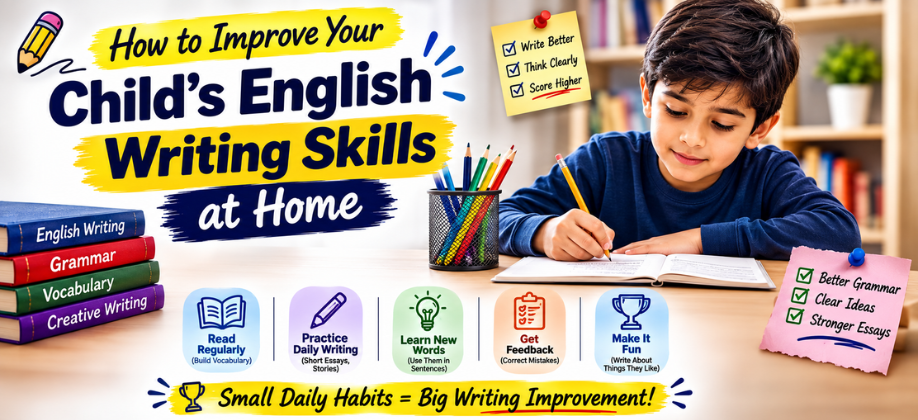
If your child is in Class 10, check the literature weightage in our CBSE Class 10 subject-wise guide. If the language section is weak too, the habits in improving English writing skills at home matter more for now.
Some students need their answers marked weekly, which is hard for a parent without a marking scheme. Dheeru Home Tuitions covers English literature for CBSE, ICSE, IGCSE and IB, listed on our subjects page alongside the learning models and programs. Ask any tutor to mark one sample answer in front of you first.