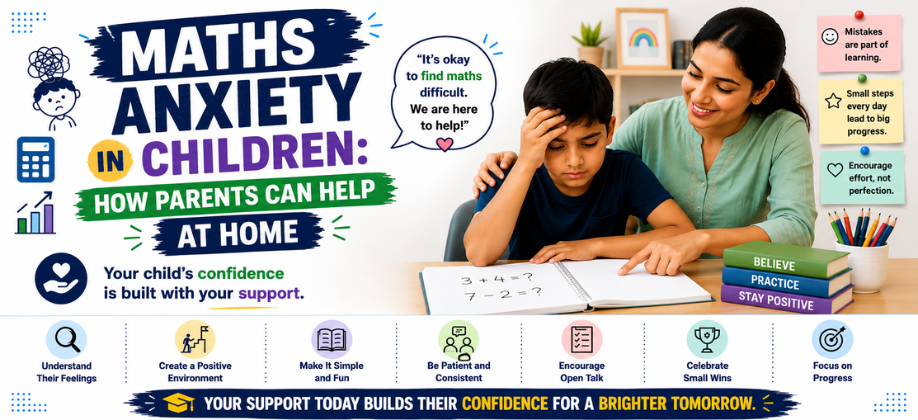
It is a Tuesday evening in Sushant Lok. Ananya, Class 5, has ten subtraction sums to finish. She has sat with the book open for forty minutes and written nothing. When her mother asks what the matter is, she says her stomach hurts.
The stomach ache is real. So is the fear underneath it. Ananya can do subtraction. What she cannot do is start a sum while an adult sits beside her, waiting.
Maths anxiety is common in Gurugram homes and it is fixable. It is not the same as being weak at maths, though it turns into that if nobody notices. Here is what it looks like, where it begins, and what helps.
What does maths anxiety look like in a child?
Maths anxiety shows up as avoidance and body complaints long before it shows up in marks. A child delays starting, hides the notebook, says "I am bad at maths" before reading the question, goes blank in a test on sums they solved at home, or gets a stomach ache on days with a maths period.
The giveaway is the gap between home and school. If your child solves a question calmly on Sunday and leaves it blank in Monday's test, the problem is not knowledge. Under stress the brain spends its capacity on worry, and little is left for holding a three-step method in place.
Signs parents often read as laziness
- Sharpening pencils and filling water before opening the maths book, but sitting down for English straight away.
- Writing an answer with no rough work, because rough work leaves visible evidence of a wrong turn.
- Saying "I did not understand anything" about a chapter they scored well in two weeks ago.
- Crying or going silent the moment you sit down to check homework.
Test it quietly before you decide
Give your child five questions from a chapter they scored badly in, with no timer and nobody watching. Leave the room. If they get three or four right alone, the marks are going to nerves, not to the topic.
Where does maths anxiety come from?
It usually comes from three places: pressure to be fast, being corrected in front of other people, and adults passing on their own maths fear. A fourth cause is quieter. One topic goes unlearned, the next sits on top of it, and within a term the child is guessing daily.
Speed pressure
Children learn early that in maths, quick equals clever. Mental maths races and timed tables tests send the same message. A child who thinks carefully starts to feel stupid, even when the working is right. Speed matters in exams. It is a terrible way to learn a new idea.
Being corrected in front of everyone
Getting a sum wrong at the board in front of thirty classmates leaves a mark. So does a parent sighing at the dining table. Children stop volunteering, then stop attempting, then stop asking doubts. The doubts pile up instead.
"I was also bad at maths"
Parents say this kindly, to make the child feel less alone. The child hears something else: this runs in my family, there is no point trying. If maths was hard for you at school, the honest version is that you were taught it badly and never got a chance to fix it.
A child who believes maths ability is fixed will stop trying long before they run out of ability.
Is it maths anxiety or a weak foundation?
Both look like poor marks, so parents often treat the wrong one. Anxiety means the skill exists but collapses under pressure. A weak foundation means a real gap in an earlier topic. Most struggling children have some of both, but one is usually driving the problem.
| What you see | Points to anxiety | Points to a topic gap |
|---|---|---|
| Solving at home, untimed | Mostly correct | Stuck at the same step |
| Test performance | Much worse than homework | Same as homework |
| Reaction to a blank page | Freezing, tears, "I cannot do it" | Starts, goes wrong midway |
| Which questions stay blank | Often the first on the paper | Always the same chapter |
| What helps | Removing pressure and audience | Reteaching the earlier topic |
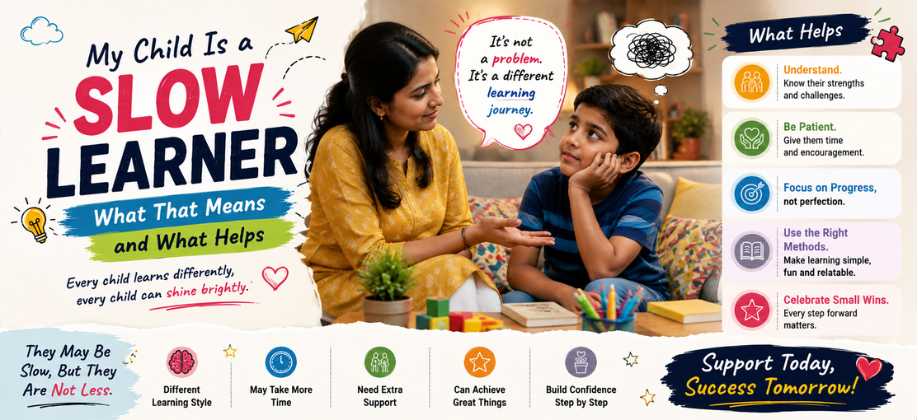
If the right column matches your child, this is unfinished learning rather than fear, and our guide on habits that raise maths marks is the better starting point. If the difficulty runs across subjects, the piece on what a slow learner really needs is closer.
Taking the timer off maths practice
Remove all timing from daily maths practice for at least four weeks. No stopwatch, no "finish in ten minutes", no comparing with a cousin or a classmate. Set a number of questions instead of a duration, and let your child take as long as they need. Speed returns once confidence does.
This feels risky, especially with boards in February and March. It is not. Speed comes from recognising question types, and that comes from unhurried practice.
- Say "do questions 1 to 6" rather than "study maths for one hour". A visible finish line reduces dread.
- Keep sessions short. Twenty minutes for Classes 4 to 7, thirty to forty for Classes 8 to 10.
- Stop while it is still going well, not after the meltdown. Ending on a solved question is what your child remembers tomorrow.
- Bring timing back only in the last weeks before exams, and only on full papers.
If exam-hall panic is the bigger issue, our article on managing exam stress works well alongside this.
Going back to the last topic your child felt sure about
Find the most recent maths topic your child could do without help, then restart from there. That might be two chapters back, or two years back. Working forward from a point of confidence beats pushing a frightened child through the chapter the class is doing today.
Parents resist this because it looks like going backwards while the syllabus moves ahead. In practice it is faster. A child solid on fractions covers ratio, percentage and algebra in weeks. A shaky one struggles with all three for years.
- Pick five questions each from three earlier chapters, spread across the last two years.
- Let your child attempt them alone, untimed, with the textbook closed.
- The last chapter they get mostly right is your starting line.
- Spend two or three sessions there rebuilding confidence, even though it feels easy.
- Move ahead one topic at a time, and treat the school chapter as revision for now.
This is what a bridging plan does. If you would rather not run it yourself, the Back-on-Track program at Dheeru Home Tuitions is built around finding that gap first.
Using objects and drawings to make maths visible
Anxious children need to see what a number is doing before they can trust a rule. Use objects and quick sketches for every new idea, whatever the class. A drawing turns an abstract instruction into something the child can check for themselves, which cuts the fear of being wrong.
- Fractions: cut a roti into eighths. Three-fourths plus one-eighth stops being a rule about denominators and becomes something you can point at.
- Negative numbers: use the lift in your building. Basement two to floor five is a subtraction your child already understands.
- Algebra: put matchsticks in a matchbox and leave some outside. The closed box is x, so "3x plus 2" sits on the table instead of being a code.
- Percentage: take a supermarket bill and work out the discount together before checking it.
For Classes 9 to 12 the same idea works through diagrams. Ask for a rough sketch before any word problem or trigonometry sum. Kabir in Class 10 who draws the ladder against the wall picks the right ratio. Kabir who does not guesses.
What to say when your child gets a sum wrong
Respond to the attempt, not the answer. Say what they did correctly first, name the exact step that went wrong, and treat it as information rather than failure. "You set the equation up perfectly, the sign flipped in line three" teaches something. "Again wrong?" teaches only that maths is where you get scolded.
- Instead of "how did you not get this", try "show me your rough work, I want to see where it turned".
- Instead of "you are so careless", try "sign errors are common in this chapter, let us keep a count for a week".
- Instead of "your friend Diya got full marks", say nothing about anyone else's marks.
- Instead of "it is so easy", try "this one is tricky, most people get it wrong the first time".
Praise effort you can see. Vague praise like "you are so intelligent" backfires, because the next hard question feels like proof the compliment was wrong. Our piece on helping with homework without doing it for them shows where to draw that line.
Never correct in front of guests
Do not ask your child to solve sums for visiting relatives, and do not discuss their marks in front of other children. Public correction is a main cause of maths anxiety, and it undoes weeks of progress in one evening.
When should you get a tutor or professional help?
Get outside help if the fear has lasted more than a term, if maths sessions at home end in tears, or if your child is a full class level behind on basics like tables, place value or fractions. A calm, patient tutor helps most children. A small number need assessment for a specific learning difficulty.
- A tutor who rushes through the school syllabus makes anxiety worse. Ask whether they will go back and fill gaps first.
- Group batches rarely suit an anxious child. Speaking up in front of other students is exactly what they are avoiding.
- Progress is slow. Expect four to six weeks before the attitude shifts, and a full term before marks move.
- Most families in Gurugram pay somewhere between Rs 8,000 and Rs 18,000 a month for one-on-one maths tuition, depending on the class, board and tutor's experience.
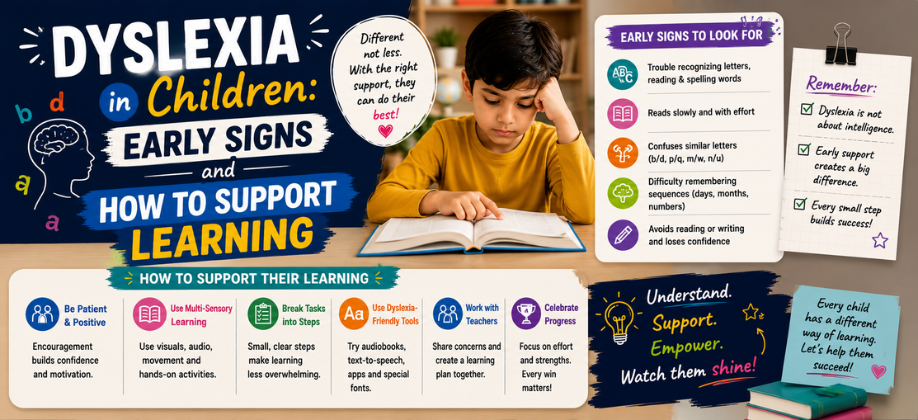
If your child has lasting trouble with number sense, reading clocks or remembering sequences well beyond their class level, ask your paediatrician or school counsellor about an assessment for dyscalculia. Support works better when it starts early, as our article on early signs of dyslexia explains.
What to do this week
Pick three things and start tonight. You do not need a new plan, a new book or a new tutor to begin. What you need is a week with no timing, no comparisons and no corrections in front of other people, so your child learns that maths is survivable.
- Run the quiet test. Five questions, alone, untimed, from a chapter they did badly in.
- Stop timing daily practice for four weeks. Set a number of questions instead.
- Find the last topic they were sure about and spend two sessions there.
- Say nothing about anyone else's marks, at home or in the school car park.
- Teach one topic this week with objects or a drawing instead of the textbook.
- Note one thing they got right each day and mention it at dinner.
Give it a month before judging whether it is working. If the tears continue and the gap keeps widening, bring in a tutor who knows the difference between a child who cannot do maths and one who is afraid of it. A free demo class lets you watch that first session before deciding.