Every June we get the same call from families in Sector 56, Palam Vihar and South City. A Class 11 student has been told to repeat the year. Or a Class 10 result has arrived two subjects short. The parent asks one thing first: can we still save this year?
NIOS is usually a word someone has already thrown at them. A cousin did it. A neighbour's son cleared it and got into a good college. Nobody explains how it works, and agents quote frightening sums to "arrange" an admission parents can do themselves.
Here is the plain version. Who can join, how admission works, what the exams involve, and which students gain from this route.
What is NIOS and how is it different from CBSE?
NIOS is the National Institute of Open Schooling, a national board under the Ministry of Education. It issues Secondary certificates, equal to Class 10, and Senior Secondary certificates, equal to Class 12. The certificate is not the difference. The school part is: you study at home or at a study centre instead of attending class daily.
Your registration stays valid for five years, and inside that window you get several chances to clear each subject. That one fact changes everything for a student who has lost time. A regular board gives you one exam a year. NIOS gives you room to breathe.
The certificate is recognised by the Government of India and by the Association of Indian Universities, so Indian colleges accept it. For JEE and NEET, read the current information brochure yourself, because the wording about open school candidates has changed more than once.
| Point | CBSE, ICSE or Haryana Board | NIOS |
|---|---|---|
| Where you study | School, every working day | Home, plus a centre for practicals |
| Attendance | Usually 75 per cent | None required daily |
| Exam sessions | One, around February and March | Two a year, plus on-demand exams |
| Chances | One a year, plus compartment | Several across five years |
| Subject choice | Fixed by the school's streams | You pick your own combination |
| Internal marks | School internals | Tutor Marked Assignments |
Who can apply for NIOS admission?
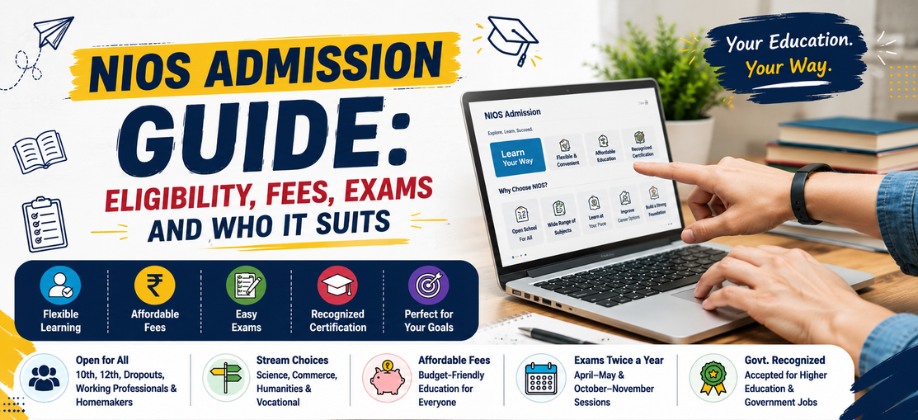
Almost anyone. For Secondary you normally need to be at least 14 on the date of admission, and no earlier certificate is demanded. For Senior Secondary you normally need to be at least 15 and to have passed Class 10 from a recognised board. There is no upper age limit.
Age and document rules get revised, so confirm them on the official NIOS website for the current session. Keep these ready:
- Age proof: a birth certificate, Aadhaar or the Class 10 certificate.
- The Class 10 marksheet and pass certificate, for Senior Secondary.
- A photograph and scanned signature in the file sizes the portal asks for.
- Proof of address, since your study centre is allotted on that basis.
- A category or disability certificate if you claim a fee concession.
NIOS streams and admission blocks explained
Streams are different doors into the same course. Stream 1 is the regular fresh admission for anyone starting from scratch. The other streams are shorter routes for students who failed at a recognised board and want to clear the level fast. Blocks are the two admission windows in a year, each pointing at one exam session.
| Route | Meant for | What it does |
|---|---|---|
| Stream 1 | Fresh learners at either level | Five-year registration, several exam chances |
| Other streams | Students who failed at another board this year | A faster route to the next NIOS exam |
| Block 1 | Admissions in the earlier window | Points you at the first exam session |
| Block 2 | Admissions in the later window | Points you at the second exam session |
Cut-off dates shift every year, and late admission costs extra. Check the current calendar on the NIOS website, not a forwarded screenshot.
Get the stream right the first time
Students who failed at another board often apply under Stream 1 by mistake and wait months longer than they needed to. Before filling the form, write down the exam session you are aiming for and work backwards. If you are unsure, call the regional NIOS office and ask which stream fits.
How to choose your NIOS subjects
You register for five to seven subjects and must pass at least five, including one language, to get the certificate. Languages usually include Hindi, English, Sanskrit, Urdu and Punjabi. Choose the rest backwards from what your child wants after school, not from what looks easy.
A student aiming at a B.Com needs Accountancy, Business Studies and Economics on the certificate. One aiming at engineering entrance needs Physics, Chemistry and Maths. It is the same thinking that goes into picking a stream after Class 10, except nobody at a school is doing it for you.
Should you take a sixth subject?
One extra subject beyond five is usually worth the fee. If one goes badly, another takes its place. Two extras, though, and all seven get studied badly.
NIOS gives you more time. It does not give you an easier question paper.
TMA, practicals and how NIOS exams work
TMA stands for Tutor Marked Assignment. For each subject you answer a set of questions in your own handwriting and submit the file at your study centre, where a tutor marks it. Those marks count towards your final result. Science and some other subjects also need practicals. The theory exam comes last.
How much weight TMA carries differs by subject and is revised from time to time, so check the current rule. Three practical points matter more than the percentage:
- Download the TMA questions for your session, not last year's. They change, and a tutor will refuse old ones.
- Submit before the deadline your centre announces, not one from a forwarded message. Late assignments sometimes do not get counted.
- Keep a phone photo of every assignment and its submission receipt.
On-demand exams
For many theory subjects, NIOS runs an on-demand exam system. Instead of waiting for the public session, you book a date at a designated centre when you are ready. It genuinely helps a student clearing one backlog paper. Not every subject or centre is covered, so confirm availability first.
Do not treat on-demand as unlimited
Students often book a slot early, fail, and book again, treating attempts as practice. Each attempt costs a fee and eats into your five-year window. Sit the paper only after finishing three full past papers under timed conditions at home.
Credit transfer: reusing subjects you already passed
If you have already passed subjects at the same level at a recognised board, NIOS lets you transfer credit for a limited number, usually up to two. Those subjects are carried onto your NIOS record and you never write them again. You apply at admission and attach the original marksheet.
Take Sanya, a Class 12 student from Sohna Road who passed English, Chemistry and Computer Science but failed Physics and Maths. She carries two passed subjects across and writes only three at NIOS. Her load drops from five subjects to three, and the year becomes winnable.
Two cautions. Credit transfer works at the same level only, and subject names must match what NIOS offers. If the mapping looks unclear, confirm it at the regional office before paying.
What does NIOS admission actually cost?
Admission for five subjects usually lands somewhere between Rs 2,000 and Rs 5,000, with a smaller charge per extra subject and separate fees for practicals, late admission and every exam attempt. Concessions apply for girl students and reserved categories. Check the NIOS website for the current year's figures before you budget.
That is only the board's cost. The real spending is on teaching, because NIOS sends books and leaves you to it. Families here usually pay between Rs 500 and Rs 1,200 an hour for a Class 10 or 12 subject tutor, close to what parents pay for regular home tuition.
Nobody needs to be paid to "arrange" NIOS admission
Admission happens on the official NIOS portal or through an Accredited Institution, and the fee schedule is published. If a centre quotes tens of thousands as a package, ask for an itemised bill separating board fees from tuition. Insist on the receipt and enrolment number in writing the same day.
Who does NIOS genuinely suit, and who does it not?
NIOS suits students whose problem is time, not ability. Illness, a family move, sport at state level, a year lost to a failed result: the student can learn the material but cannot follow a school calendar. It suits far less well the student who is avoiding work, because open schooling removes the last outside pressure.
It usually works well for
- Students who lost months to illness or treatment and cannot make up school attendance.
- Athletes and performers whose training or tournament schedule clashes with the school day.
- Students who failed one or two subjects and want to clear the level in months, not a year.
- Older learners who left school long ago and need a certificate for a job or college seat.
- Families who have moved and face a mid-year board change no school will absorb smoothly.
It usually goes badly for
- Students who cannot start work without someone standing over them. Freedom is the hardest part, not the syllabus.
- Families choosing it because they think it is easier. The papers are set at board level and the pass mark is real.
- Students who need daily friends and a fixed timetable. A year alone at home is heavier than it sounds.
- Anyone applying abroad without first checking, in writing, whether those universities accept open schooling.
The honest trade-off is this. NIOS hands your child the calendar and walks away. Some students grow up fast under that. Others drift for four months and then panic. If your child drifts, build structure from day one: a fixed daily slot, a tutor who checks work weekly, and a routine they will follow. Our Back-on-Track bridging programme at Dheeru Home Tuitions was built for this group.
What to do this week
Start with facts, not opinions. Confirm the current admission block, the stream that matches your situation, and the subjects your child needs for the course they want next. Those three answers decide everything else, and all three can be settled in a few days without paying anyone.
- Open the official NIOS website and note the current admission dates, fees and eligibility rules for your level.
- List the five subjects your child will take, then check them against the entry requirements of two courses they might apply to.
- If your child has passed subjects elsewhere, take the marksheet to the regional office and ask whether credit transfer applies.
- Ask the nearest Accredited Institution when TMA submission and practicals happen, since those dates shape the year.
- Build a study plan before the first book arrives. Working backwards from the exam session, along the lines of a realistic six-month timetable, keeps freedom from becoming drift.
One last word for parents. A child who has failed carries more embarrassment than you can see, and open schooling can feel like being quietly removed from normal life. Treat it as a different route, not a demotion, and watch how they cope with exam pressure. To talk subject choice through with a teacher first, book a free demo session and bring the marksheet along.