Ishaan is in Class 7. He sits down at six with his science book open at the chapter on light. At half past seven his mother finds the same page, three sharpened pencils, one paper aeroplane and no notes.
The same boy spent two hours on Sunday building a pulley from an old motor and never looked up. At every school meeting his family in Sector 56 hears the same two words. Bright. Careless.
If your evenings look like this, the problem is usually not effort or attitude. Attention works differently for some children, and more scolding will not fix it. What helps is changing the shape of the study session.
Why is studying so hard for a child with ADHD?
For a child with ADHD, the hard part is rarely understanding the topic. It is starting, staying on one thing, and remembering what came next. Most of their energy goes into holding the task in mind instead of doing it. Long sittings, vague instructions and a crowded desk make that much harder.
This is why "just concentrate" fails. It asks the child to supply the one thing they do not have easily. External structure supplies it instead. You are not lowering the bar, you are building a ramp up to it.
One thing before we start. This is not medical advice. ADHD is diagnosed by a qualified professional, never by a school report or an internet checklist. The ideas below help many children who find focus hard, diagnosis or not.
| What is hard | What it looks like at home | What to try first |
|---|---|---|
| Starting | Book open, thirty minutes gone, page still blank | Say the first two minutes out loud: "write the date, copy question one" |
| Staying on one thing | Begins maths, ends up reading the atlas | One book on the desk, everything else zipped into the bag |
| Holding instructions | Forgets step two of a three-step question | Write the steps on a card and leave it beside the page |
| Finishing | Work is done but never submitted | A checklist whose last line is "put it in the school bag" |
How long should a study block be for a child with ADHD?
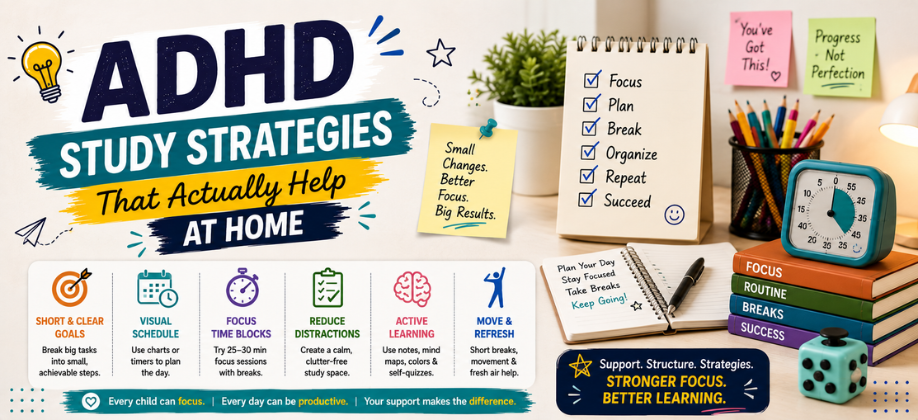
Start much shorter than feels useful. Ten to fifteen minutes for Classes 3 to 5, fifteen to twenty for Classes 6 to 8, and twenty to twenty-five for Classes 9 to 12. Then a proper break. Four short blocks that get finished beat one ninety-minute sitting that quietly falls apart.
Give the block a finish line your child can see. "Do questions 1 to 6" works better than "study maths till seven". A number of questions ends. Time does not feel like it ever will.
How to run the block
- Agree what will be done before the timer starts, and write it on a slip of paper.
- Put the phone in another room, not face down on the table.
- Stop the moment the timer goes, even mid-question. Breaking a promise about the break kills the system.
- End the evening on a block that went well, not after the meltdown. That is what your child remembers.
Say the first step out loud
Starting is the biggest hurdle, so do not leave it to your child. Sit for ninety seconds and say exactly what to write: heading, date, question number. Once the pen is moving, walk away. Most children carry on much longer than you expect.
Using movement breaks without losing the whole evening
A good break is short, physical and has a clear end. Five minutes of stairs, skipping, or a run down to the society park. Set a timer for the break too. Movement resets attention, while lying on the bed or picking up a phone stretches into thirty minutes.
Parents worry that breaks waste time. The opposite is true. Four focused blocks with movement between them finish more work than two restless hours in a chair.
Breaks that work and breaks that backfire
- Works: ten jumping jacks, a lap of the corridor, five minutes of badminton in the passage.
- Works: a snack that needs hands, like peeling an orange. It busies the body without pulling in the mind.
- Backfires: phones, tablets, any game with levels. None of them has a natural stopping point.
Screens make a poor break
A five-minute video is never five minutes, and returning to the chapter afterwards feels twice as hard. Keep screens out of the study evening and save them for after dinner. Our article on balancing screen time and studies shows how to set that limit without a daily fight.
A child with ADHD is not choosing chaos, they are working twice as hard to hold on to what other children keep without trying.
Keeping one task visible at a time
Put exactly one thing in front of your child: one book, one worksheet, one question. Everything else goes off the desk and out of sight. A page of twenty sums reads as one enormous job, so cover the rest with a blank sheet and show four at a time.
- Clear the desk to one book, one notebook, one pen and one pencil. Spares live in the drawer.
- Cut long worksheets into strips, or fold the page so only the current section shows.
- Use a sticky note to mark where today's reading stops. An open chapter has no visible end.
- Keep a rough sheet for stray thoughts. Writing "ask about football camp" down gets it out of the way.
Building structure your child can see
Structure only works if it lives outside your child's head, on a wall or a board where anyone can look at it. Same time, same place, same order every day. A written plan removes the daily negotiation about what to study, which is where most evenings are lost.
Keep the routine boringly repetitive. Once the order stops being a decision, it stops being a fight. Our guide on building a daily study routine your child will follow has a template you can adapt.
Checklists that actually get used
A checklist here has to be short, physical and specific. Three or four lines on a whiteboard beside the desk, ticked off with a marker. Long typed lists on a phone get ignored within two days.
- Write actions, not subjects. "Science Ch 6, questions 1 to 5" beats "Science".
- Include the boring last steps: sign the diary, pack the geometry box, put the bag by the door.
- Let your child do the ticking. The tick is the reward, and handing it over matters.
Sitting in the room helps. Taking over does not, and that line is drawn well in our piece on helping with homework without doing it for them.
Setting up a low-distraction study space at home
Pick one fixed spot, face it towards a plain wall rather than a window or a doorway, and strip everything off it except today's work. In a Gurugram flat that may be a corner of the bedroom or one end of the dining table. Consistency matters far more than furniture.
Noise is the harder half. Construction in New Gurugram, the TV in the drawing room, a younger sibling, the doorbell. You cannot remove all of it, so plan around the worst hour.
- Fix study time for the quietest hour, even if that means five thirty in the morning for a Class 10 student.
- Over-ear headphones with steady background sound help many children. Music with lyrics usually does not.
- Agree one rule for the whole house: during a block, nobody calls out to the child.
- Anything your child can reach without standing up will be played with, so keep the shelf bare.
If space is tight, our guide to setting up a study space in a small flat has workarounds for shared rooms.
Does one-on-one tuition help a child with ADHD?
Usually yes, and much more than a crowded batch. A patient tutor sitting beside your child notices drifting within seconds, repeats an instruction without embarrassment, and adjusts the pace to that particular day. A classroom of forty, or a coaching hall of a hundred, cannot do any of that.
| Crowded classroom or coaching batch | Patient one-on-one tutor at home |
|---|---|
| Instruction given once, to everybody | Repeated and rephrased until it lands |
| Drifting goes unnoticed for twenty minutes | Noticed almost immediately and redirected |
| Breaks decided by the timetable | Break taken when attention drops |
| Mistakes corrected in front of classmates | Mistakes stay between two people |
The tutor matters more than the format. Someone who talks for forty minutes straight will lose your child anyway. Ask how they will keep a session active, and watch a demo first. Our comparison of home tuition versus coaching centres covers the trade-offs.
What to ask a prospective tutor
- Have you taught a child who finds it hard to sit still, and what did you change?
- How will you break a one-hour class into shorter pieces?
- Will you send me two lines after each session on what was covered and what is still weak?
Be ready for slower, bumpier progress. Some weeks go backwards. Fees in Gurugram usually sit between Rs 6,000 and Rs 18,000 a month depending on class, board and experience, with special education training at the upper end. At Dheeru Home Tuitions this comes under special education support, and a free demo class is the cheapest way to see whether a tutor suits your child.
When should you get a professional assessment?
Get an assessment if the difficulty shows up in more than one setting, has lasted six months or longer, and is holding back learning, friendships or your child's view of themselves. Start with your paediatrician or the school counsellor, who can refer you to a child psychologist or developmental paediatrician for proper testing.
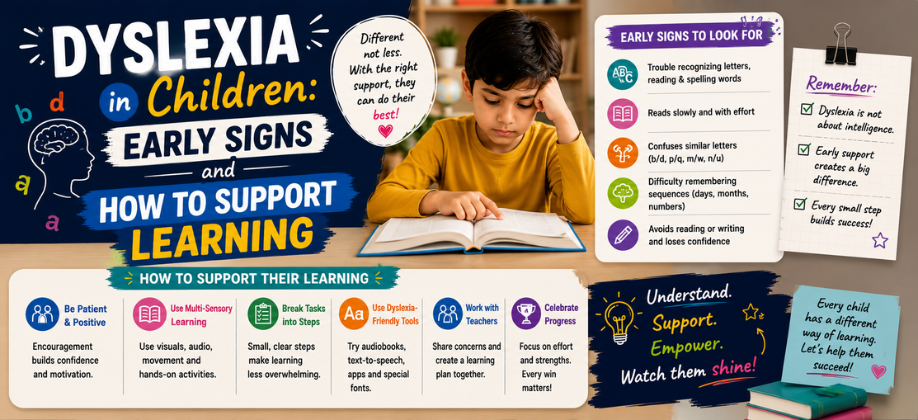
Parents often delay because they fear a label. A clear assessment usually brings relief instead, for the child most of all. It also separates ADHD from things that look similar, such as poor sleep, a hearing problem, anxiety, or a difficulty like the one in our article on early signs of dyslexia.
Ask the school what support exists
Most schools have a counsellor and can arrange small adjustments, such as a front-row seat or extra time in class tests. CBSE, ICSE, IB and IGCSE all have provisions for students with assessed needs, and the paperwork changes each year. Check the official board website.
What to do this week
Change two things, not ten. Pick the two that suit your home best, run them for a full week without judging the results, and only then add anything else. Trying every idea at once is exactly how these systems collapse by Thursday and leave everyone feeling worse.
- Cut the study block in half and add a five-minute movement break, with a timer for both.
- Clear the desk to one book and one notebook before your child sits down, every day.
- Put a small whiteboard beside the desk and write three specific tasks on it each evening.
- Move the phone to another room for the whole study session, yours included.
- Spend ninety seconds getting the first line written, then leave the room.
- Note one thing that went well each day and say it out loud at dinner.
Give it three or four weeks. If evenings still end in tears, or your child is slipping across subjects, speak to your paediatrician and look for a tutor used to children like yours.