It is 7.15 on a Tuesday evening in Sushant Lok. Ananya, Class 8, has been at her desk since six. Her phone lies face down next to the geometry box. In seventy minutes she has finished four sums out of twelve, and she has picked the phone up eleven times.
Her mother tried taking it away completely. That lasted three days and ended in a shouting match. Homework instructions arrive on a class WhatsApp group, and the science worksheet is a PDF.
That is the honest difficulty with screen time and studies now. The screen is the distraction and the textbook at once. A flat ban does not survive one normal school week, so you need rules that tell the two apart.
Why do screen time rules break down at home?
Screen rules usually break down because they treat every screen as the same thing. A child reading a chemistry worksheet on a laptop and a child watching short videos both look identical to a parent walking past. So a rule like "one hour a day" ends up punishing schoolwork, and the argument starts again.
Three other things quietly kill most rules:
- The rule was made in anger: A phone taken away after a bad unit test feels like a punishment for marks. It comes back within a week.
- Only the child has a rule: If the television runs at dinner and you answer office mail on the sofa at 10 pm, the rule reads as unfair.
- There is no plan for doubts: If a child cannot check what page 84 said, the phone returns in ten minutes. Every rule needs a legal way to get that information.
Separating study screens from entertainment screens
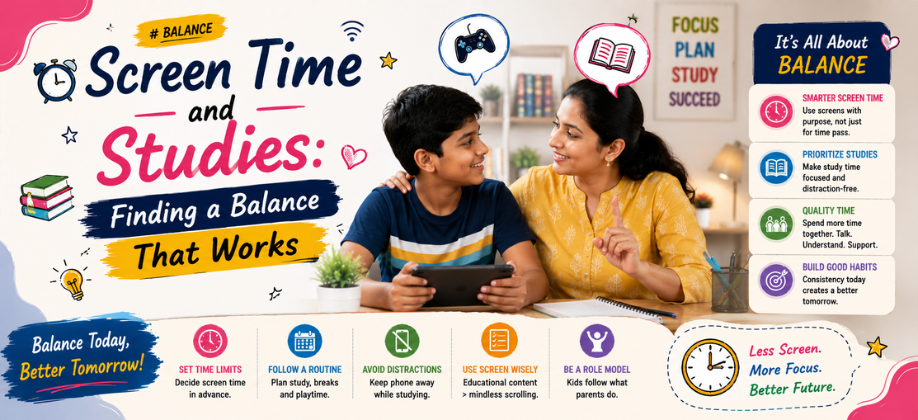
Sort the screens in your house into two piles. Study screens carry school work: the worksheet PDF, a recorded class, a maths explanation video, the online tuition session. Entertainment screens carry games, videos, chats and social apps. Count the two separately, give each its own rule, and stop measuring the day as one total.
Both piles usually sit on the same device, so you have to separate them physically:
- Keep study work on a laptop and entertainment on the phone. The phone can then leave the room without breaking anything.
- Make a second browser profile with only school bookmarks and no logged-in social accounts.
- Download the worksheet or video before the study block starts, so nothing is searched for mid-session.
Try the two-list test
For three days, ask your child to note two numbers on paper: minutes on study screens and minutes on entertainment screens. Most parents get a surprise in both directions. The study number is smaller than assumed, the other one bigger.
How much entertainment screen time is right for each class?
There is no single correct number, and any site giving you one to the minute is guessing. What follows is what works for most families in Gurugram. Keep a small amount on school days, a longer slot on weekends, and no screens in bedrooms at night. Adjust it to your own child.
| Class | School day | Weekend | Where the device sleeps |
|---|---|---|---|
| Classes 1 to 3 | About 30 minutes | An hour, in two sittings | No personal device |
| Classes 4 and 5 | 30 to 45 minutes, after homework | Up to 90 minutes | Shared tablet, outside bedrooms |
| Classes 6 to 8 | An hour, one agreed slot | Two hours, plus a film | Drawing room after 9.30 pm |
| Classes 9 and 10 | 45 to 60 minutes, after dinner | Two to three hours | Out of the bedroom by 10 pm |
| Classes 11 and 12 | An hour, reviewed weekly | Agreed, not policed | Out of the bedroom by 11 pm |
Two honest warnings. In board exam months, roughly January to March, the school-day number drops on its own. And a child with heavy sport or music already has little free time, so cutting further usually backfires.
Setting up phone-free study blocks
A phone-free study block is a fixed stretch of study, usually 30 to 45 minutes, with the phone in a different room. Not face down, not on silent, not in the bag. In another room. The block ends with a short break in which the phone may be checked.
- Agree the length first: Classes 6 to 8 manage 30 minutes, Classes 9 and 10 manage 45, Classes 11 and 12 can do an hour. Longer blocks get abandoned by Thursday.
- Fix a landing spot: A bowl on the dining table, the same place daily, so nobody hunts for a phone at 9 pm.
- Give them a doubt slip: Anything needing a search gets written on paper instead of looked up now.
- Use a real timer: A kitchen timer or a clock. A phone used as a timer is a phone in the room.
- Make the break a real break: Ten minutes away from the desk, phone allowed, then it goes back.
This works far better when the desk itself is right. Our guide on setting up a study space at home covers the light and the corner. It pairs well with a daily study routine that has fixed start times.
The doubt slip changes everything
Most phone pickups during study start out genuine: one word to check, one message to a friend. The slip lets that thought leave the head without the phone entering the hand. Clear the slip in five minutes at the end.
How do screens affect attention and sleep?
Two effects are broadly agreed on. Research on attention consistently finds that switching between tasks carries a cost, and returning to deep work after an interruption takes several minutes. Late screen use also pushes bedtime later, and that is the part parents can actually see the next morning.
The attention part
Say Rohan checks his phone every eight minutes while doing physics. He is not losing eight seconds each time. He is losing the thread of a problem he had just begun to hold in his head. An interrupted hour produces about twenty minutes of real work.
Children who already find focus hard feel this much more sharply. If your child drifts even with no phone in the room, screen rules alone will not fix it. Our post on studying with attention difficulties has better tools.
The sleep part
A Class 10 student catching a 6.45 am bus needs to be asleep by about 10.30 pm. A phone in the bedroom pushes that to midnight, quietly, night after night. The tiredness then shows up as irritability, weak marks in the first two periods, and what looks like laziness.
A phone in the bedroom at night costs more marks than any chapter your child skipped.
Tiredness and screen habits also feed exam anxiety, covered separately in our guide to managing exam stress.
Negotiating screen rules with a teenager instead of banning
With a teenager, a rule you impose lasts about two weeks. A rule they helped write lasts a term. Sit down on a calm Sunday, not after a bad result, and ask them to propose the rules first. Then negotiate two or three points and stick the agreement on the fridge.
- "How much time is fair on a school night?" Their first number is higher than yours, but rarely absurd.
- "When should the phone leave the room?" Let them own the timing, so long as the study block is protected.
- "What happens if the rule breaks twice in a week?" A consequence they chose is hard to argue against later.
Be honest about the trade-off. A hard ban does work in the short term, especially in the last month before boards. It also pushes usage out of sight, and a Class 11 student who wants a phone at 1 am will find one.
Review the agreement every fortnight and change one thing. If sleep and marks are fine, loosen something. Some teenagers, though, have stopped seeing the point of studying at all. Our post on how to motivate a child who does not want to study deals with that separately.
What if the tuition and homework are already online?
Then the screen is the classroom, and you manage it like one. Fix the session at the same time daily, at a proper desk rather than on the bed, camera on, every other tab closed. Keep the phone in another room even during class, because a laptop lesson plus a phone equals half a lesson.
- Log in three minutes early with the notebook open, or the first ten minutes go into settling.
- Ask the tutor to end with two questions your child answers out loud. It is the quickest way to know whether the hour landed.
- Keep a shared doubt log, so the next session starts with the points that stayed unclear.
If online sessions keep drifting, an in-person tutor at the same desk removes the problem. Start with online versus offline home tuition. Dheeru Home Tuitions runs both, and the programs page explains how each one works.
Do parents need to change their own screen habits too?
Yes, and this is the part most families skip. Children copy what they see far more than what they are told. If you scroll on the sofa while asking a Class 9 son to concentrate, the rule reads as a power move. Your own habits set the ceiling for the house.
- No phones at dinner, including yours: Twenty-five minutes, every day. This carries more weight than any lecture.
- Read something while your child studies: A parent quietly working nearby makes the study block feel normal instead of imposed.
- Say what you are doing on the phone: "Replying to a work message, five minutes." Children cannot tell work from scrolling unless you name it.
The television counts
Background television is the most underrated distraction in Indian homes. A child studying two rooms away still hears the dialogue and the ad breaks. Switch it off for one study block and see whether the same homework takes less time.
What to do this week
Pick the first three items and leave the rest for next month. Trying to change everything on a Monday is why most screen plans die by Friday. Small visible changes that the whole family follows will beat a strict plan only your child is expected to follow.
- Track study screens and entertainment screens separately for three days, before changing any rule.
- Choose one landing spot for phones and put a bowl there tonight.
- Run one 30-minute phone-free block tomorrow, with a paper doubt slip and a real timer.
- Move all devices out of bedrooms after 10 pm, starting with your own.
- Book a fifteen-minute Sunday talk to write the family rules on paper, with your teenager proposing first.
- If schoolwork itself is the problem, book a free demo session and let a tutor watch how your child studies for an hour.
One last thing. If a phone-free hour produces the same four sums a phone-filled hour produced, the phone was never the real issue. A basic feature phone for emergencies costs somewhere between Rs 1,500 and Rs 3,000, and for some families that settles the argument. For others, it only moves it.