Aarav's Class 10 pre-board maths paper came back with 71 out of 80. His mother read the script twice. A minus sign dropped while opening a bracket, one answer written in centimetres when the question said metres, a three-mark part left blank on the back page. He knew all those chapters.
Teachers across Gurugram see this script every February. The child understands the work. The marks say something else.
Silly mistakes feel random, so families treat them as a character flaw: "she is just careless". They are not that. They are a system problem, and a system can be rebuilt in about three weeks.
Why do students make silly mistakes in exams?
Silly mistakes in exams happen because a student is doing three jobs at once: reading the question, recalling the method, and writing fast under time pressure. Reading gets the least attention of the three. The error is usually not in the concept. It sits in what the student thought the question said.
A few ordinary things make it worse:
- Speed anxiety: The student in the next row turns her page, so you rush your reading.
- Practice without pressure: Homework is done slowly with the textbook open. The exam is the first attempt at speed.
- Scattered rough work: If step four is squeezed sideways into a corner, step five copies the wrong number.
- No checking habit: Many students hand the paper in early and call it confidence.
None of these are about intelligence. All four are habits, which means all four can be trained.
The five kinds of silly mistake that cost the most marks
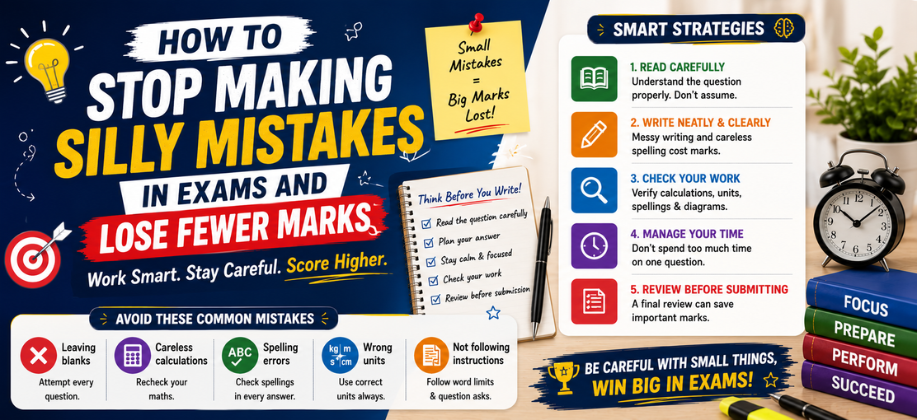
Almost every lost mark falls into five types: misreading the question, unit and sign errors, copying errors between lines, skipped parts of a question, and messy presentation. Each one has a different fix. Naming the type matters, because "be careful" is not an instruction anyone can follow inside an exam hall.
| Type of mistake | What it looks like | The fix that works |
|---|---|---|
| Misreading the question | Describing when asked to compare; solving for x when it wanted 2x | Underline the command word, write the target in the margin |
| Unit and sign errors | Grams instead of kilograms; a minus lost while opening a bracket | Write the unit in the same pen stroke as the number |
| Copying errors | Correct working, wrong figure in the answer box | Compare the answer against the last line of working |
| Skipped parts | Part (c) never attempted, or a back page missed | Tick each part as you finish, then count the ticks |
| Presentation slips | Two questions on one line, steps crammed, answer not underlined | One question per fresh block, answer underlined |
Subjects lean towards different types. Maths and physics lose marks to signs and units. English and social science lose them to command words, where a long description gets written for a question that asked for two differences.
Name the mistake, not the feeling
When you go through a checked paper, say the type out loud. "Unit error, third one this month" is useful. "I am so stupid" is not. Students who can name their top two error types start catching them mid-exam.
Keeping an error log after every test
An error log is a thin register where you record every mark you lost, in four lines, within a day of getting the paper back. You write the paper and question number, what you actually did wrong, the correct step, and a one-word tag such as "unit" or "misread". Nothing more.
The tag is the whole point. After four or five papers you stop guessing and start seeing. Ananya in Class 12 logged her Class 11 finals and found most of her lost physics marks were units and copying errors, not concept gaps. She needed a checking routine, not more theory.
What one entry looks like
- Paper: Class 10 maths, unit test 2, Q7(b).
- What I did: Found x correctly, then wrote the value of 2x on the answer line.
- Correct step: The question asked only for x.
- Tag: misread, second time this term.
Keep it to four lines. Students abandon the log when they start copying whole solutions and it eats an hour. Ten minutes per paper, no more. If your child keeps an error notebook for practice sums, as described in our guide to maths habits that actually work, use the same register.
Then read the log before every exam. Not the textbook. Just the tags from the last three papers, which takes four minutes.
How to read an exam question without misreading it
Read every question twice before your pen moves, then mark it up. Underline the command word, circle every number and unit, and write in the margin what the answer should look like. This costs about twenty seconds per question and is the highest-return habit in this article.
Command words carry marks:
- State or name: one line, no explanation. Extra sentences earn nothing and cost you minutes.
- Explain or why: a reason, usually with the word "because" somewhere in it.
- Compare: both sides inside the same sentence, not two separate paragraphs.
- Find or calculate: a number, with its unit, underlined.
Writing the target in the margin is the part everyone skips. Before solving, jot "want: time in seconds" or "want: 3 differences". Your own note then tells you whether you answered the question that was asked. Students working through physics numericals gain the most, because the data given and the quantity wanted are often different.
Setting up rough work you can actually check
Rough work should sit in a narrow column, be numbered to match the question, and never be erased. If your working is scattered across the sheet, you cannot trace a wrong answer back to the step that broke. Traceable rough work turns a five-minute recheck into a thirty-second one.
- Draw a light vertical line one-third from the right edge. Everything for question 7 goes under a heading "7".
- Never rub out a wrong step. Cross it with one line. If the answer looks odd, that crossed step is often where the truth hides.
- Carry the unit down every line, not only at the end. A stray "cm" three lines up catches conversion errors early.
Practise the way you will write
If homework is always done on loose sheets, the exam is the first time the real format is used. Ask for two practice sets a week on a full answer sheet, laid out the way the board expects. Our guide on presentation marks in board exams covers the layout.
The 5-minute checking routine at the end of a paper
Keep the last five minutes for a fixed sequence instead of random rereading. Check that every part is attempted, then that every final answer carries a unit, then the three questions you felt least sure about. Follow the same order every time, so you never waste seconds deciding what to check.
- Minute 1, count: Tick every part you attempted. Blank parts and missed back pages are the cheapest marks in any exam.
- Minute 2, units and signs: Look only at final answers. Does each carry a unit? Does any have an impossible sign, like negative time?
- Minute 3, the shaky three: Go back to the three questions you dotted while attempting the paper, in that order.
- Minute 4, transfers: For two long questions, compare the last line of working with the figure you wrote as the answer.
- Minute 5, the obvious: Roll number, question numbers in the margin, extra sheets tied in order.
Rereading shows you what you meant to write; checking shows you what you actually wrote.
That is why checking so often fails. Students reread their own reasoning, agree with themselves, and move on. Checking works when you look at surfaces: units, signs, figures copied, parts attempted.
How to slow down without running out of time
Slow down at the start of each question and speed up in the middle. Spend twenty seconds reading and marking up, then keep moving rather than polishing answers that have already earned their marks. Careful reading costs roughly three minutes across a full three-hour paper, and usually saves far more.
| Stage of a 3-hour paper | Time to give it | What you are doing |
|---|---|---|
| Reading time before writing | 15 minutes, where allowed | Read the whole paper, dot three unsure questions, fix your order |
| First pass | About 105 minutes | Answer everything you know well, without perfecting wording |
| Second pass | About 70 minutes | Attempt the dotted questions and the long answers you left |
| Final check | 5 minutes | The routine above, in the same order every time |
This will not suit every student. If you finish with twenty minutes in hand and still lose marks, slower reading is exactly your fix. If you never finish on time, adding twenty seconds a question will hurt, and your real problem is writing speed. That needs full timed papers, which our piece on using sample papers the right way explains.
Two timed papers a week, not five
Speed comes from sitting a full paper with a clock on the table, then marking it strictly. Two a week in the last two months is plenty. Any more and there is no time to fix what the papers show.
What parents can do at home
Sit with the checked paper, not the report card. Ask your child to point at each lost mark and name the error type. Keep your voice flat and curious. If the reaction at home is anger, papers start disappearing into school bags, and you lose your only real data.
Three things help more than extra hours:
- Ask "what did the question actually ask for?" before "why did you get it wrong?" It sends attention back to reading, where the damage happened.
- Run a twenty-minute timed set at the dining table twice a week. Five questions, a clock, no phone.
- Watch for nerves rather than carelessness. A child who blanks and rushes may be facing real exam fear, and our guide on managing exam stress helps more than another worksheet.
If one tag keeps repeating after a month, a tutor can help by marking strictly and refusing any answer without a unit. At Dheeru Home Tuitions we ask tutors to spend the first ten minutes of a session on the last test rather than the next chapter. This is where one-on-one and small group formats differ most: in a batch of eight, nobody checks your rough work line by line.
What to do this week
Start with one paper and one register. Take the most recent checked test, log every lost mark with a tag, and count the types. Then pick the commonest tag and build one habit against it for two weeks. One habit at a time, not five.
- Today: find the last two checked papers and log them. Ten minutes each.
- Tomorrow: count your tags and write the top one on the first page of the register.
- This week: do two timed sets of five questions using the mark-up habit.
- Next test: use the five-minute routine, even if one long answer ends up shorter.
- After that test: log again and compare the tag counts with your first paper.
Progress here looks boring. Two fewer unit errors. One part no longer left blank. Across a full board paper that is often six to ten marks, all of them from chapters the student already knew.