It is the second week of February. Your daughter has her Class 12 Chemistry paper on Friday. She has been at her desk since seven, but the same page has been open for an hour. Last night she said she has forgotten everything she ever studied. She has not.
Most homes in Gurugram see some version of this fortnight. The child who stops eating properly. The one who studies till 2 am and sleeps through the morning. The one who is calm until somebody on the class group announces four finished revisions.
A little exam stress is useful. It gets students to the desk. The trouble starts when it stops helping: when sleep goes, recall goes, and one bad paper feels like the end of everything.
What are the signs of exam stress in students?
Look for changes rather than moods. Common signs are broken sleep, headaches or stomach aches with no medical cause, loss of appetite, irritability, and long hours at the desk with very little finished. Many stressed students also stop meeting friends and start saying they will fail everything.
| Where it shows | What it looks like | Worth acting on when |
|---|---|---|
| Sleep | Awake till 2 am, or waking at 4 am with a jolt | It continues for more than a week |
| Body | Headaches, stomach pain, nausea before school | The doctor finds nothing wrong and it keeps returning |
| Behaviour | Snapping at everyone, crying easily, avoiding the desk | It is new for this child, not their usual nature |
| Study pattern | Long hours, nothing completed, endless rewriting of notes | Two weeks pass with no chapter actually finished |
| Talk | "I will definitely fail", "no point studying now" | They say it flatly, without wanting an argument |
One honest caution. Not every low mood in February is exam stress. Teenagers also have friendship trouble and ordinary bad weeks. Ask before you diagnose.
Sleep, food and movement during exam season
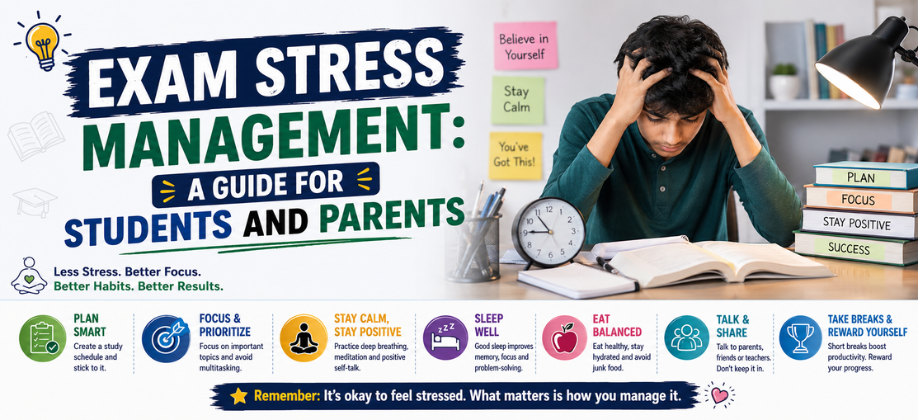
Protect seven to eight hours of sleep, eat normal home food at normal times, and get twenty minutes of walking every day. These three things sound too simple to matter. They decide how much of the studying stays in the head and how steady a student feels in the exam hall.
Sleep is study time, not wasted time
Memory settles during sleep. A student who studies till 2 am on five hours of sleep remembers less of that night's work than one who stopped at 11 pm. Late nights also create a false sense of effort, which is why students defend them.
- Fix a lights-off time and hold it within thirty minutes every night, including before a paper.
- Stop new learning an hour before bed. Use that hour for formulae, diagrams or the weak list.
- Charge the phone in another room. If it is the alarm, a Rs 300 alarm clock ends the argument.
Food and caffeine
Exam eating goes wrong in two ways: skipping meals, or living on Maggi and cold coffee. Both leave a student shaky by mid-afternoon. Regular dal, roti, curd, eggs, fruit and nuts do more than any brain supplement in the market. Two cups of tea or coffee a day is fine; four cups plus an energy drink at 10 pm causes the exact racing heart everyone blames on nerves.
Do not cut sleep to add study hours
If your child is short of time, cut the low-value work instead: rewriting notes neatly, highlighting, the third read of a known chapter. Sleep is the last thing to touch. Tired students lose more marks to careless errors than to gaps in knowledge.
Study techniques that lower exam anxiety
Most exam anxiety comes from not knowing what you know. Self-testing fixes that. Close the book, write everything you remember from a chapter on a blank sheet, then check what is missing. Students who test themselves feel calmer, because their confidence rests on evidence rather than hope.
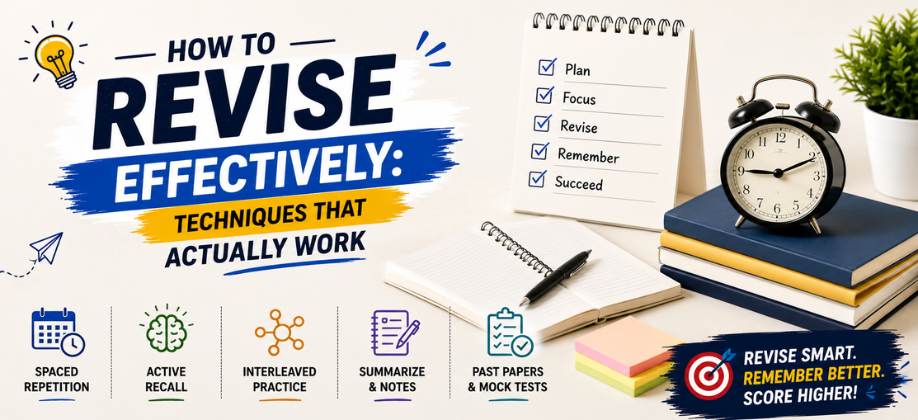
Studies on memory consistently find that testing yourself beats rereading. Rereading feels smooth, so students prefer it, then freeze when a question is worded differently. Our guide on revision techniques that actually work has the method.
- Turn the vague into a list: "Physics is a disaster" is frightening. "Chapters 4, 7 and 12, mainly the numericals" is a task.
- Write one full paper under real timing: Three hours, phone in another room, one sitting. Fear of the hall drops once the body has done three hours before. Our notes on using sample papers the right way cover the checking.
- Work in blocks, not marathons: Fifty minutes of work, ten minutes standing away from the desk. A break spent scrolling leaves the head more tired, which is why screen time in exam months needs a rule.
Subject fear is worth naming. A student who panics at the sight of numbers may have maths anxiety rather than laziness, and that responds to easier questions first, not more pressure.
Exam stress rarely comes from the exam. It comes from what a child believes a bad result will cost them at home.
What should parents say during exam season?
Say less about marks and more about the next hour. Useful sentences are small and specific: "What are you doing between now and dinner?" or "Which chapter is bothering you most?" Avoid comparisons, avoid predictions about their future, and avoid asking how the paper went the moment they walk out.
| Instead of | Try | Why it works better |
|---|---|---|
| "Aarav is scoring 95, what are you doing?" | "Your last test was 68. What gets you to 75?" | Compares the child to themselves |
| "Do not stress, it is just an exam" | "This does feel heavy. What is the worst part?" | Dismissing the feeling teaches them not to tell you |
| "Your whole future depends on this" | "Boards matter. They are not the only door." | Lowers the stakes to something a teenager can carry |
| "You have wasted the whole year" | "We have three weeks. Let us plan them." | The past cannot be revised, the next three weeks can |
| "How was the paper?" at the gate | "Come, eat something first." | Gives them an hour before any post-mortem |
Children read your face more closely than your words. A sigh at the dinner table lands harder than a lecture. If you are anxious, handle it with your partner, not in front of the child.
Mute the class group for a month
Parent WhatsApp groups turn into a scoreboard in February. Somebody's child has finished six revisions, somebody has a leaked paper theory. Mute the group and check it twice a week.
What to do after a bad paper mid-exam season
Treat it as one paper and protect the next one. No post-mortem, no comparing answers with friends, no calculating the final percentage that evening. Let your child eat, rest for an hour, then start the next subject. Marks lost in a written paper cannot be recovered by discussing them.
Rohan, a Class 10 student in South City, came out of his Science paper certain he had failed. His mother asked nothing. She gave him lunch, let him sleep an hour, and at four they sat with the Maths syllabus. His Science mark turned out fine. His Maths mark was better for it.
- Feed them and let them be quiet: No questions for an hour. Most students settle if nobody prods.
- Ban the answer-key hunt: Checking answers on YouTube between papers ruins the next exam.
- Name what is ahead: "Four papers left" is a fact worth saying out loud. It moves attention forward.
- Do a light session: Formulae, diagrams, one short answer set. Restart the engine, do not cover new ground.
- Say the sentence: "One paper does not decide anything. I am not angry." Many children need to hear it plainly.
If the paper really was bad, compartment and improvement options exist for board students, and a route such as NIOS is not the disaster it is made out to be. Check the official board website for this year's rules.
What to do when your mind goes blank in the exam hall
Put the pen down and breathe out slowly for about six seconds, three or four times. Then read the easiest question on the paper and start there. Blanking is a stress response, not memory loss. It usually clears within a minute or two once the body settles and the hand starts moving.
- Use the reading time to mark questions you can do straight away, and start with those. Beginning at question one out of habit is a common mistake.
- If a formula will not come, write what you do remember about the topic. Recall often returns sideways.
- Leave a hard question, mark the margin, come back. Fifteen stuck minutes cost marks everywhere else.
Careless slips rise sharply when a student is anxious, so read this with how to stop making silly mistakes in exams. For the final stretch, see the last 30 days before board exams.
When does exam stress need professional help?
Get help if your child talks about self-harm or about not wanting to be here, has panic attacks, stops eating or sleeping for several days, or withdraws completely for more than two weeks. These are not exam nerves. Start with a paediatrician, the school counsellor, or a qualified child psychologist.
Any mention of ending life must be taken seriously the same day, even if it sounds casual. Do not wait for the exams to finish.
- The school counsellor: Most Gurugram schools have one, and they know the exam calendar and the pressure in that school.
- Your paediatrician or family doctor: Useful to rule out physical causes and to get a referral.
- Government helplines: Tele-MANAS is a free national mental health helpline; its current number is on the official website. Some boards run counselling lines in exam season, so check the board site.
- A clinical psychologist or psychiatrist: Needed for self-harm, panic attacks or a long low period. Asking early is not an overreaction.
Academic pressure and mental health are different problems
A tutor can fix a shaky Physics chapter. A tutor cannot treat depression or an anxiety disorder. If both are present, get the mental health support first and keep the academic side light until things steady.
What to do this week
Pick one evening and do four small things: agree a lights-off time, ask your child to write out the shaky chapters, block one Sunday morning for a full paper, and decide the sentence you will say after a bad exam. Small and specific beats a long talk.
- Set the sleep window tonight and hold it, even before a paper. Move the phone charger out of the bedroom.
- Ask for the weak-chapter list in writing. If they cannot make it, sit with the syllabus and build it together.
- Fix two regular meal times and a twenty-minute walk. The society park is enough; nobody needs a gym.
- Mute the parent WhatsApp group and stop marks talk at the dinner table for a month.
- If one subject is causing most of the fear, get help for that subject alone rather than for everything. You can book a free demo class to see whether the teaching style suits your child.
Students who do well in February are rarely the ones who studied longest. They are the ones who slept, knew which chapters were weak, and were not scared of what a bad paper would mean at home. That last part is mostly in your hands.