It is the first week of September. Your child is in Class 10, the first unit test results are back, and two subjects are weaker than you expected. Someone at the society gate on Sohna Road mentions that their son already studies six hours a day. You come home and announce a new rule. By Thursday nobody is following it.
This happens in most homes. The problem is almost never willingness. It is that a six-hour rule made in one evening ignores school, tuition, football practice, and the fact that a fifteen-year-old cannot sit still for six hours on day one.
What follows is a month-by-month plan from September to February, for both Class 10 and Class 12. It is built around what a normal school-going student can actually manage, and it includes what to change when you fall behind. Because you will.
When should board exam preparation start?
Start a structured board exam preparation timetable in September, about six months before the February and March exams. Six months is enough for syllabus completion, two full revisions and a long run of sample papers. Plans made in April usually collapse by June, because there is no exam pressure yet to hold them together.
By September a few useful things are true. The school has covered roughly half the syllabus. One unit test is done, so you know which subjects are weak instead of guessing. October brings festival holidays, a free block of days. And there is still time for one bad month to be repaired.
If you are reading this in November or December, do not panic and do not jump straight to cramming. Start at the revision stage and compress. Our guide to the last 30 days before board exams has a tighter plan for students short of time.
The six-month plan at a glance
Each month has exactly one main job. September and October are for finishing the syllabus, November for the first full revision, December and January for sample papers and a second revision, and February for polishing weak areas. Trying to do two jobs in one month is what makes students feel permanently behind.
| Month | Main job | You are on track if |
|---|---|---|
| September | Stay ahead of school in weak subjects | Every chapter taught in class is covered, with your own notes |
| October | Close the remaining syllabus using the festival break | Only two or three chapters per subject are left |
| November | First full revision, chapter by chapter | You can name your weak chapters, not just feel uneasy about them |
| December | Full sample papers under exam timing | You have written at least four complete papers |
| January | Second revision plus more papers | Your scores stop swinging wildly from paper to paper |
| February | Final polish, formulae, presentation, sleep | You are revising, not learning anything new |
Print this table. Stick it above the study table. A plan that lives inside a parent's head is not a plan, it is a worry.
September and October: finishing the syllabus
Use these two months to cover every chapter once, including the ones the school has not reached yet. Try to stay one or two chapters ahead of the class in your weakest subject. Make short notes as you go. A chapter counts as finished only when you can solve questions from it with the book shut.
How to order your subjects
- Start each study session with the subject you dislike most, while your head is still fresh. Most students do the opposite and leave Maths for 10 pm, when nothing goes in.
- Give the weakest subject four sittings a week, the middle ones two or three, and the strong one just enough to keep it warm.
- Keep one subject per evening as the main focus, with a shorter second slot for revision of yesterday's work.
Take Ishaan, a Class 12 commerce student. Accountancy was his weak spot, so he covered partnership and company accounts on his own before the school reached them. When the class got there, the lesson became free revision instead of first contact.
Do not make beautiful notes
Notes should take minutes, not hours. Two or three points per topic, plus the formula or the definition in your own words. Colour-coded, rewritten, decorated notes feel like studying but are mostly copying, and copying is the weakest way to remember anything.
November: the first full revision
November is for going through every chapter a second time, quickly, and sorting each one into three piles: solid, shaky, or not learnt. This is a sorting job, not a re-reading job. Test yourself on a chapter first, then study only the parts the test showed you had forgotten.
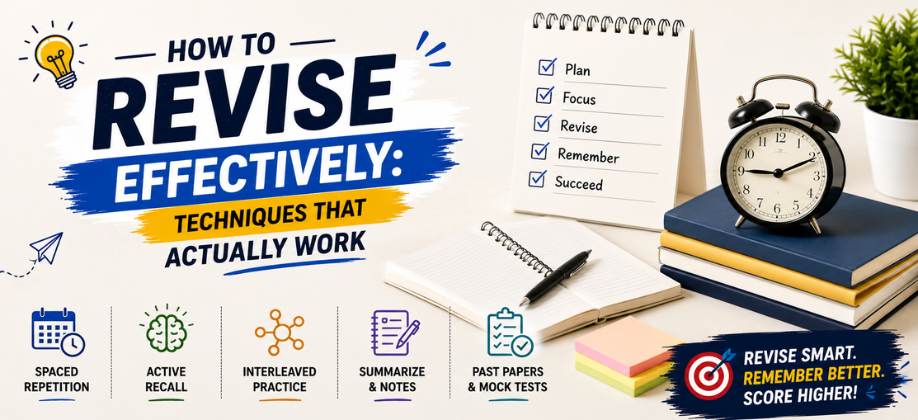
The method is simple. Close the book, write everything you remember from the chapter on a blank sheet, then open the book and see what is missing. Studies on memory consistently find that testing yourself beats rereading. There is more in our piece on revision techniques that actually work.
A chapter you have read four times and never once tested yourself on is a chapter you do not know.
Keep a single register called the weak list. Every shaky chapter goes in it, along with the exact topic that failed. Not "Chemistry weak" but "mole concept, limiting reagent sums". That register becomes your entire study plan for January and February.
December and January: sample papers and the second revision
From December, write full sample papers under real exam timing, one subject at a time, and spend as long checking each paper as you spent writing it. Two papers a week is plenty. January repeats this while you run a faster second revision of everything marked shaky back in November.
Most students write a paper and then look only at the score. That wastes it. After every attempt, split your lost marks into three groups:
- Did not know it: Send the chapter back to the weak list and study it again this week.
- Knew it but ran out of time: A speed problem. Practise that question type against a clock, not the whole chapter.
- Knew it and still got it wrong: Careless error. Read our notes on how to stop making silly mistakes in exams, because these marks are the cheapest ones to recover.
Use the official sample papers and past board papers for your board first, and only then the ones sold in Sector 14 book shops. Question patterns change, so check the official board website for the current year's format. Our guide on using sample papers the right way goes into the marking side in more detail.
Write the paper in one sitting
A three-hour paper attempted in three separate half-hour bits teaches you almost nothing about exam stamina. Sit down at 9 am on a Sunday, phone in another room, and finish the whole thing. The tiredness you feel at the two-hour mark is exactly what you are training against.
How many hours a day should a board student study?
On a school day, aim for two to three hours of focused self-study in Class 10 and three to four hours in Class 12. On Sundays and holidays, five to six hours split into blocks with real breaks. Steady weekly hours beat one heroic ten-hour Sunday followed by an empty week.
| Stage | School day (Class 10) | School day (Class 12) | Sunday or holiday | Where the hours go |
|---|---|---|---|---|
| September to October | 2 to 2.5 hours | 3 hours | 4 to 5 hours | New chapters 70 per cent, revision 30 per cent |
| November | 2.5 hours | 3 to 3.5 hours | 5 hours | Self-testing 60 per cent, relearning 40 per cent |
| December to January | 3 hours | 4 hours | 5 to 6 hours | Papers and checking 60 per cent, weak list 40 per cent |
| February | 3 hours | 4 hours | 5 hours | Weak list 50 per cent, formulae and papers 50 per cent |
Inside a three-hour evening, a workable shape is 50 minutes of work, 10 minutes off, repeated three times. The break must be a real break: water, a walk on the balcony, something to eat. A break spent scrolling is a different kind of tiredness. If your child has no routine yet, start with building a daily study routine they will actually follow.
What to do when your child falls behind
When you fall behind, cut the plan, not the sleep. Drop the lowest-value work first: neat rewriting, highlighting, and chapters that carry very few marks. Keep the self-testing, the sample papers and the weakest subject. Then rebuild the timetable from today's date instead of trying to repay lost weeks.
Falling behind is normal. Gurugram students lose weeks to fevers, school events, pre-boards, practicals and family functions. Here is the repair sequence:
- Count what is actually left: Sit with the syllabus and list the untouched chapters. The real number is usually smaller than the panic suggests.
- Sort those chapters by marks: Do the heavy-weightage ones first. A six-mark chapter and a two-mark chapter are not worth the same evening.
- Accept one subject will be weaker: If time is short, aim for a solid pass in your strongest area of a weak subject rather than a thin coverage of everything.
- Add outside help only for the specific gap: Not five subjects. One or two, with a tutor who starts by testing rather than teaching from page one.
Be honest about what tuition can and cannot fix. Two extra hours a week will not rescue a student starting Class 12 Physics in January with nothing done. It can rescue a student who understands most chapters but keeps losing 15 marks to numericals. Dheeru Home Tuitions runs a Back-on-Track bridging program for exactly that second case.
Watch for the shutdown, not the sulk
Grumbling about studying is normal. A child who stops opening books at all, sleeps at odd hours or goes quiet is telling you something else. Reduce the target for a week and talk before you push. Managing exam stress matters more in December and January than any timetable.
What to do this week
Pick one free evening and do four things: list every chapter in every subject, mark each one as done, shaky or not started, write the six-month plan on a single sheet, and stick it where your child studies. Then decide which one subject genuinely needs outside help, and which does not.
- Download the current syllabus for each subject from your board's official website. Do not rely on last year's printout, since chapters and weightage get changed.
- Make the three-pile list per subject. Take your child's word for what is shaky, then check it with five questions.
- Fix the daily study slot at a time that already exists, such as 6 pm to 9 pm on school days. A slot invented at 5 am rarely survives a week.
- Book the two Sundays in October you will use for full sample papers, before other plans fill them.
- If one subject needs a tutor, arrange a free demo class now rather than in December, when good tutors across DLF Phase 3, Sushant Lok and New Gurugram are already booked.
Six months looks long from September and very short from January. The students who do well are rarely the ones who studied the most hours. They are the ones who knew, every single week, which chapter was the weakest and what they were doing about it.