What CISCE has released, and where to download it
On 10 November 2026, the Council for the Indian School Certificate Examinations published the complete, official examination schedules for both ICSE Class 10 and ISC Class 12 on its primary website, cisce.org. In the previous year, the council issued the 2026 timetable on 13 November 2025, making this release slightly earlier.
Early publication provides essential clarity. As discussed in our analysis comparing CBSE vs ICSE, CISCE designs extended examination schedules with substantial revision intervals between major subjects. This single national timetable applies uniformly to every affiliated school in the country, maintaining identical examination rules and dates nationwide.
Download the unmodified circular PDFs directly from the Notice Board at cisce.org. Aggregator websites often publish incorrect timetables with inverted shift timings or subject codes. CISCE remains the single reliable source of truth.
ICSE 2027: full exam window and subject-wise dates
The ICSE Class 10 examination window spans 15 February 2027 to 31 March 2027, covering six and a half weeks. Papers commence with English Language (Paper 1), followed by English Literature (Paper 2), core sciences, Mathematics, humanities, and electives. Reading time of ten to fifteen minutes precedes writing, as specified in council guidelines.
| Date | Day | Subject and Paper Name | Start Time | Duration |
|---|---|---|---|---|
| 15 February 2027 | Monday | English Language (English Paper 1) | 10:00 AM | 2 Hours |
| 17 February 2027 | Wednesday | Literature in English (English Paper 2) | 10:00 AM | 2 Hours |
| 22 February 2027 | Monday | History and Civics (H.C.G. Paper 1) | 10:00 AM | 2 Hours |
| 26 February 2027 | Friday | Geography (H.C.G. Paper 2) | 10:00 AM | 2 Hours |
| 3 March 2027 | Wednesday | Second Languages (Hindi and Regional Languages) | 10:00 AM | 3 Hours |
| 8 March 2027 | Monday | Mathematics | 10:00 AM | 2.5 Hours |
| 12 March 2027 | Friday | Physics (Science Paper 1) | 10:00 AM | 2 Hours |
| 16 March 2027 | Tuesday | Chemistry (Science Paper 2) | 10:00 AM | 2 Hours |
| 20 March 2027 | Saturday | Commercial Studies / Economics | 10:00 AM | 2 Hours |
| 24 March 2027 | Wednesday | Biology (Science Paper 3) | 10:00 AM | 2 Hours |
| 29 March 2027 | Monday | Computer Applications / Physical Education / Electives | 10:00 AM | 2 Hours |
| 31 March 2027 | Wednesday | Environmental Science (Concludes ICSE) | 10:00 AM | 2 Hours |
ISC 2027: full exam window and subject-wise dates
The ISC Class 12 examination window runs from 9 February 2027 to 8 April 2027, spanning eight and a half weeks. While Class 10 papers run in the morning session, ISC theory papers commence at 2:00 PM in the afternoon, with designated reading time at 1:45 PM.
This extended schedule provides multi-day breaks between major subjects. The table below summarizes the key papers across Science, Commerce, and Humanities.
| Date | Day | Subject and Paper Name | Start Time | Duration |
|---|---|---|---|---|
| 9 February 2027 | Tuesday | English Language (English Paper 1) | 2:00 PM | 3 Hours |
| 12 February 2027 | Friday | Literature in English (English Paper 2) | 2:00 PM | 3 Hours |
| 16 February 2027 | Tuesday | Economics | 2:00 PM | 3 Hours |
| 20 February 2027 | Saturday | Commerce | 2:00 PM | 3 Hours |
| 24 February 2027 | Wednesday | Physics (Theory Paper 1) | 2:00 PM | 3 Hours |
| 27 February 2027 | Saturday | Indian / Foreign Languages | 2:00 PM | 3 Hours |
| 3 March 2027 | Wednesday | Chemistry (Theory Paper 1) | 2:00 PM | 3 Hours |
| 9 March 2027 | Tuesday | Mathematics | 2:00 PM | 3 Hours |
| 15 March 2027 | Monday | Accounts | 2:00 PM | 3 Hours |
| 19 March 2027 | Friday | Political Science / Biotechnology | 2:00 PM | 3 Hours |
| 23 March 2027 | Tuesday | Biology (Theory Paper 1) | 2:00 PM | 3 Hours |
| 27 March 2027 | Saturday | History | 2:00 PM | 3 Hours |
| 31 March 2027 | Wednesday | Computer Science (Theory Paper 1) | 2:00 PM | 3 Hours |
| 3 April 2027 | Saturday | Business Studies / Sociology | 2:00 PM | 3 Hours |
| 8 April 2027 | Thursday | Psychology / Electives (Concludes ISC) | 2:00 PM | 3 Hours |
Why ISC students have less time than everyone else this year
Examining the national examination calendar reveals a clear mathematical reality. ISC Class 12 begins on 9 February 2027, while ICSE Class 10 begins on 15 February 2027 and CBSE examinations start on 16 February 2027. Consequently, ISC candidates start six days before their Class 10 schoolmates and a week before CBSE candidates.
From 17 November 2026, an ICSE candidate has approximately 90 days until their opening paper, whereas an ISC student has roughly 84 days. That six-day margin represents an entire revision cycle. Moreover, ISC syllabi in Physics, Chemistry, Mathematics, Accounts, and Economics require deep conceptual derivations and step-by-step problem solving that cannot be accelerated at the last moment.
How to read your own timetable: map your gaps before you plan anything
Do not treat the master timetable as a simple list. Because it contains dozens of elective combinations, the raw schedule creates a deceptive feeling of abundant time. Construct a personalized Gap Map that records only your registered subjects and the exact calendar days between successive papers.
Two contrasting situations require careful management:
- The Wide Gap Trap: Major papers preceded by five to seven days often lure students into procrastination. Fatigue after earlier exams can quickly consume an unstructured week.
- The Tight Gap Crunch: Electives or languages separated by only forty-eight hours leave room only for quick formula revision and error review. New concepts cannot be learned in a two-day interval.
The 90-day plan, week by week
Because the examination period spans six to eight weeks, preparing only up to the first examination leaves the remainder of the testing season vulnerable. A complete board revision plan must govern both pre-exam preparation and the intermediate gap days between papers.
Our four-block roadmap anchors output goals to calendar milestones rather than fragile daily timetables.
| Block and Timeframe | What to Finish | Papers to Solve | What to Write by Hand | One Thing to Stop Doing |
|---|---|---|---|---|
| Block 1: Late November (About 2 weeks) |
Close open syllabus chapters. Finalize textbook exercises and write your Gap Map. | Zero full papers. Only chapter-end question sets. | Formula sheets, chemical reaction lists, and character quotes for literature. | Stop passive re-reading with highlighters without solving active questions. |
| Block 2: December (About 4 weeks) |
First complete syllabus revision cycle, aligned with school pre-board examinations. | One full paper per week under strict timed exam conditions. | Full analytical answers, derivations, and mathematical proofs from memory. | Stop multitasking between three or four subjects in the same morning block. |
| Block 3: January (About 4 weeks) |
Second targeted revision driven strictly by your personalized Error Log. | Two full papers per week under timed conditions with objective marking. | Correction sheets breaking down every mistake made in pre-board papers. | Stop opening new reference guides or unfamiliar question banks. |
| Block 4: February (1 to 2 weeks plus gaps) |
High-yield summary review, rapid formula recall, and execution of gap-day routines. | One final diagnostic paper per upcoming paper spaced safely in advance. | Daily fifteen-minute rapid recall sheets of definitions and diagram outlines. | Stop irregular sleep schedules and studying through late night hours. |
Block 1: The rest of November (about two weeks)
The objective of late November is closure. You cannot revise an open syllabus. Finish any remaining textbook chapters and draft your Gap Map. In English Literature, see our guide on English literature answer writing for character analysis strategies. For numericals, review our tips on physics numericals. Avoid full mock exams in this phase; concentrate on conceptual clarity.
Block 2: December (about four weeks)
December is your primary revision phase, coinciding with school pre-boards. Alternate between quantitative and descriptive subjects using our framework on how to revise effectively. By late December, solve one full three-hour paper each week under strict time limits, applying the principles in our guide on how to use sample papers.
Block 3: January (about four weeks)
January focuses on precision. Re-reading entire textbooks delivers diminishing returns. Direct your revision through a dedicated Error Log documenting every mistake from December practice. Increase testing to two timed papers weekly and use our checklist on how to avoid silly mistakes in exams. ISC candidates should complete heavy testing by 25 January.
Block 4: February up to the first paper, and the gap-day routine
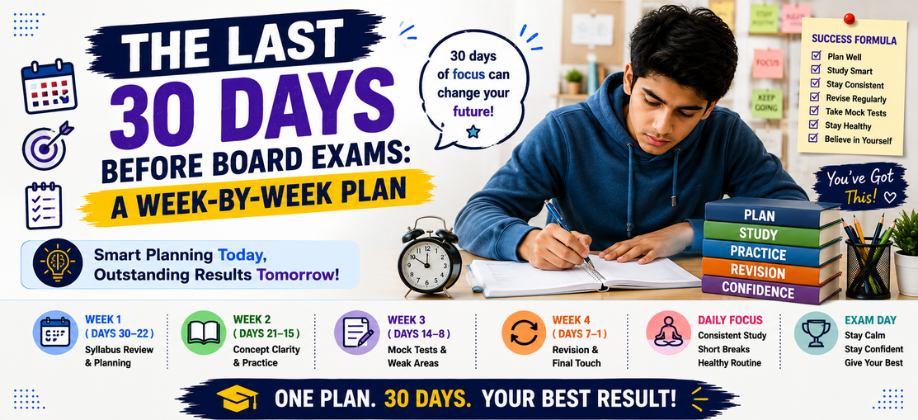
During February, introduce no unfamiliar books. The final seven to ten days before your first paper belong exclusively to your opening two subjects. For multi-day intervals between papers, apply our framework from the last 30 days board exam strategy: day one reviews and audits chapters, day two solves timed questions, and the final evening reviews formulas before early rest.
Paper timings and what they do to your daily routine
A crucial operational difference between ICSE and ISC lies in the daily examination clock. ICSE papers run in the morning session, with designated reading time starting at 10:00 AM. ISC theory papers take place in the afternoon session at 2:00 PM, with advance reading time given at 1:45 PM.
This schedule directly influences peak performance. An ICSE student who studies until late night hours will suffer fatigue at 10:00 AM. Conversely, an ISC student used to afternoon naps will feel sluggish during 2:00 PM papers. From December onward, simulate full papers during your exact official exam hours. Synchronizing biological alertness reduces test-day anxiety, as discussed in our guide on managing student exam stress.
ISC students sitting JEE Main or CUET: the April problem
For senior school students in the Science stream, the 2027 timetable creates an important overlap known as the April Problem. According to the National Testing Agency schedule on jeemain.nta.nic.in, JEE Main Session 2 runs from 2 April 2027 to 7 April 2027. Meanwhile, ISC examinations continue through 8 April 2027.
An ISC Science candidate may sit a board theory paper and a JEE Main shift within the same week. Plot both exam schedules onto one master calendar now. Board derivations directly strengthen competitive conceptual clarity. Maintain periodic computer-based mock tests in February to preserve speed. For undergraduate admissions, the Common University Entrance Test (CUET UG) is expected in May 2027 and remains unnotified. Explore competitive paths in our analysis of CUET vs JEE vs NEET.
Admit cards, results and what is not yet announced
Several administrative dates have not yet been notified by the council. Distinguish verified announcements from previous patterns:
- Admit Card Distribution: In previous years, CISCE released admit cards to principals in January, with schools issuing stamped copies two to three weeks before examinations.
- Declaration of Results: In previous years, CISCE announced ICSE and ISC results in May, with digital scorecards published via DigiLocker.
- Recheck and Supplementary Guidelines: Official recheck rules are announced after the completion of the main examination series on cisce.org.
What to do this week
Take these four practical steps before the end of the week:
- Download and Print: Visit cisce.org, download the authentic 2027 timetable PDF, and place printed copies on your study desk.
- Draft Your Gap Map: List your registered subjects in sequence and record the exact leave days between each paper.
- Confirm School Practical Dates: Obtain your school's laboratory practical and viva schedule in writing.
- Audit Unfinished Chapters: Identify any remaining syllabus topics and establish a completion deadline before November ends.
This examination guide and 90-day revision framework are provided completely free for every ICSE and ISC family across India and CISCE schools abroad. If you happen to live in Delhi or Gurgaon, we also provide verified, one to one home tuition for ICSE and ISC subjects, with a free demo class before you make any commitment. You can explore our ICSE and ISC subject tuition or view the specific areas we cover in Delhi and Gurgaon. For all families reading elsewhere in the country, this timetable analysis and revision structure are yours to use freely.