A mother in South City sent us a photo of her daughter's IGCSE mock result slip one October evening. Sanya had a 7 in Physics, a B in Business Studies and a C in Maths, all on the same page. Her mother's question was short: is a 7 better than a B, and why are there two systems on one slip?
She is not the only one asking. Schools in Gurugram run Cambridge and Pearson Edexcel syllabuses side by side, and the two do not always use the same scale. Even inside Cambridge, one subject may report numbers while the next reports letters.
Here is what each scale means, how the two line up, and what a grade actually tells you about your child's work.
Why does one IGCSE result slip show both numbers and letters?
Because Cambridge International offers two versions of many syllabuses: one graded A* to G and one graded 9 to 1. The school picks the version, subject by subject, when it enters students. Pearson Edexcel International GCSE has moved most subjects to 9 to 1. A single student can easily end up with both scales.
The clue is the syllabus code on the statement of entry. Cambridge IGCSE Mathematics carries code 0580 on the A* to G version and 0980 on the 9 to 1 version. Same subject, same standard, different reporting scale.
If you are not sure, do not guess from the report card. Ask the exams officer for the syllabus codes in writing.
What does the IGCSE 9-1 grading system mean?
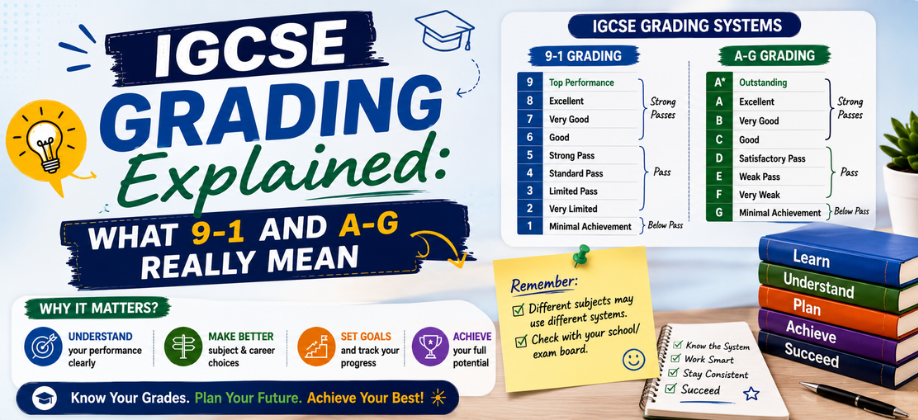
On the 9 to 1 scale, 9 is the highest grade and 1 is the lowest graded result. Anything below 1 is reported as U, which means ungraded. Grade 4 is treated as a standard pass and grade 5 as a strong pass. Grade 9 was designed to be harder to reach than the old A*.
The change happened because of crowding at the top. Under A* to G, a large group of strong students all landed on A* and nobody could tell them apart. The numeric scale splits that group into 9, 8 and 7.
Two things parents often get wrong about the 9:
- A 9 is not "90 per cent". There is no fixed percentage attached to any grade, and the mark needed changes with every exam session.
- A 9 is not the normal target for a strong student. Only a small share of the students who reach grade 7 and above go on to get a 9. An 8 is already an excellent result.
How do 9-1 grades compare to A*-G grades?
The two scales are lined up at three fixed points. The bottom of grade 7 matches the bottom of grade A. The bottom of grade 4 matches the bottom of grade C. The bottom of grade 1 matches the bottom of grade G. Everything in between is spread across the remaining numbers, so the match is close but not exact.
| 9-1 grade | Closest A*-G equivalent | What it usually shows |
|---|---|---|
| 9 | Above A* | Near-complete accuracy, including the hardest unfamiliar questions |
| 8 | A* | Very strong across the paper, a few marks dropped on extended answers |
| 7 | A | Confident with standard questions, handles most unfamiliar ones |
| 6 | High B | Solid, but loses marks on multi-step and explain-why questions |
| 5 | Low B or high C | Strong pass; content known, application uneven |
| 4 | C | Standard pass; the usual minimum for Year 11 entry |
| 3 | D | Gaps in basic content show up under time pressure |
| 2 | E or F | Only the simplest questions answered correctly |
| 1 | G | Lowest graded result |
| U | U | Ungraded; no grade is reported for that subject |
Use this table for reading a report card, not for arguing with an admissions office. If a school asks for A or above, a 7 satisfies it. If it asks for A* in Maths, a 7 does not.
What does a grade 7 or an A really represent?
A grade 7 or an A means your child answers standard questions accurately and gets through most unfamiliar ones. It is not perfection. In many subjects a 7 sits somewhere around two-thirds to three-quarters of the total marks, though the exact figure moves every session. The last few marks are what separate a 7 from a 9.
Where the missing marks usually sit
With IGCSE students across DLF Phase 4 and Sushant Lok, the gap between a 7 and a 9 is rarely about knowing less. It is a handful of repeating habits.
- Six-mark explanation questions answered in three lines, with no link between cause and effect.
- Unit conversions dropped in Physics and Chemistry calculations, especially cm to m and g to kg.
- Data response questions in Economics and Business where the student describes the table instead of using it as evidence.
- Maths answers with the right method and no working shown, so method marks are lost when the final number is wrong.
A grade describes what your child could do in two hours on one particular morning, not who your child is.
Read the mark scheme, not just the mark
Sit with your child and one past paper they have already attempted. Go through the official mark scheme line by line and mark it yourself. You will usually find that two or three specific habits, repeated across the paper, account for most of the lost marks. Our guide on using sample papers the right way covers how to run this properly.
Core and Extended papers: how grade ceilings work
Many Cambridge IGCSE subjects run at two levels. Core papers cover less content and cap the highest possible grade at C, or 5 on the numeric scale. Extended papers cover more and go up to A*, or 9. A Core student who answers every question correctly still receives a C. The school decides the level at entry.
Pearson Edexcel does something similar in some subjects with Foundation and Higher tiers. The names differ, the effect is the same. Check the current syllabus document on the board's own website, because tier ranges are reviewed from time to time.
Which subjects are usually tiered
- Mathematics, in almost every case.
- The three sciences, and Combined or Co-ordinated Science.
- English as a Second Language, where the tier affects the top grade available.
- Some languages and Geography, depending on the syllabus version the school uses.
The trade-off is real and it cuts both ways. Entering a struggling student for Extended can end in a U instead of a safe D. Entering a borderline student for Core protects the pass but shuts the door on IB Higher Level Maths and on most A Level science courses. Neither choice is automatically kind.
Ask about the tier before the entry deadline
Entries are usually finalised months before the exam, and changing them afterwards is difficult or impossible. Ask your child's subject teacher, in a written message, which tier they plan to enter your child for and what evidence they are using. This is one of the most useful things to raise at a parent-teacher meeting.
If your child is on Core Maths and you think they can manage Extended, you have a window, not forever. Two terms of steady work on algebra and problem solving can change the picture, and our post on building better maths habits lists the practice that does it.
How are IGCSE grade boundaries decided each year?
Boundaries are set after each exam session, once examiners can see how difficult the paper turned out to be. A harder paper gets lower boundaries; an easier one gets higher boundaries. That is why no fixed percentage guarantees an A or a 9, and why marks from an old past paper only mean something against that same session's boundaries.
This matters for home practice. If your child scores 62 on a 2019 paper, look up the 2019 boundaries for that specific paper and variant. Comparing that 62 against a different year's boundary table gives a false reading, sometimes by a whole grade.
Cambridge statements of results also carry a percentage uniform mark for each subject. It is a scaled figure, not a raw percentage, so results from different sessions can be compared fairly. Indian schools that insist on a percentage will often accept it.
How do Indian schools and universities read IGCSE grades?
Indian universities admit on Class 12 results, not on IGCSE, so IGCSE grades mainly decide what your child is allowed to study in Years 11 and 12. Indian schools accepting a transfer after Year 10 ask for the statement of results and usually an equivalence letter. Requirements change, so confirm the current ones with the school and check the official board website for the year in question.
What the grades actually gate
- IB Diploma Higher Level entry: Most schools want a 6 or 7, or an A or A*, in a subject before allowing it at HL. This is the single biggest reason IGCSE grades matter, and it is worth reading alongside our guide to choosing HL and SL subjects.
- A Level entry: Similar bar, usually a 6 or above in the same or a closely related subject.
- Moving to CBSE or ISC for Class 11: Possible, but schools set their own conditions and the syllabus jump is sharp. Families who have done this describe the adjustment in our post on changing boards mid-year.
- Foreign university applications: Some UK universities still check IGCSE English and Maths as a minimum requirement, even when the offer is based on Year 12 results.
One honest point. A parent hoping their child's IGCSE grades will impress an Indian university is aiming at the wrong target. Those grades open doors inside school. The Class 12 qualification does the university work, which is why the difference between IGCSE and the IB Diploma is worth understanding early.
What to check on your child's results this week
Take twenty minutes with the latest report or mock result slip and work through five things. It tends to surface problems while there is still time to fix them.
- Note the scale for every subject: Write down which subjects are 9 to 1 and which are A* to G, so you stop comparing grades that are not on the same ruler.
- Find the tier for each tiered subject: Core or Extended, Foundation or Higher. If nobody at home knows, email the school today.
- Check the ceiling against the plan: If your child wants HL Chemistry in the IB Diploma, a Core science entry will not get them there.
- Look at one paper in detail, not the average: Averages hide the pattern. A single marked script tells you far more.
- Fix a date to review again: Six to eight weeks is enough to see whether a change in study habits is showing up in marks.
If a subject is two grades below where it needs to be, that is usually a content gap plus an exam-technique gap, and both need separate attention. Our learning programmes and subjects page show which IGCSE syllabuses we cover.
Grades are useful information. They are not a verdict. Read them carefully, ask the school the questions above, and you will know far more than the grade letter alone tells you.