A father from Sushant Lok called us one evening in February. His daughter Ananya had to submit her IB Diploma subject form by Friday, and the family had spent the whole weekend arguing. She wanted Visual Arts at Higher Level. He wanted a second science instead.
That argument runs in a lot of Gurugram homes at this time of year. The form itself looks harmless. Six boxes, three marked Higher Level and three marked Standard Level. Those boxes then shape two years of work and quietly decide which university courses stay open.
Here is how to fill that form with reasons instead of guesses.
What are the six IB subject groups?
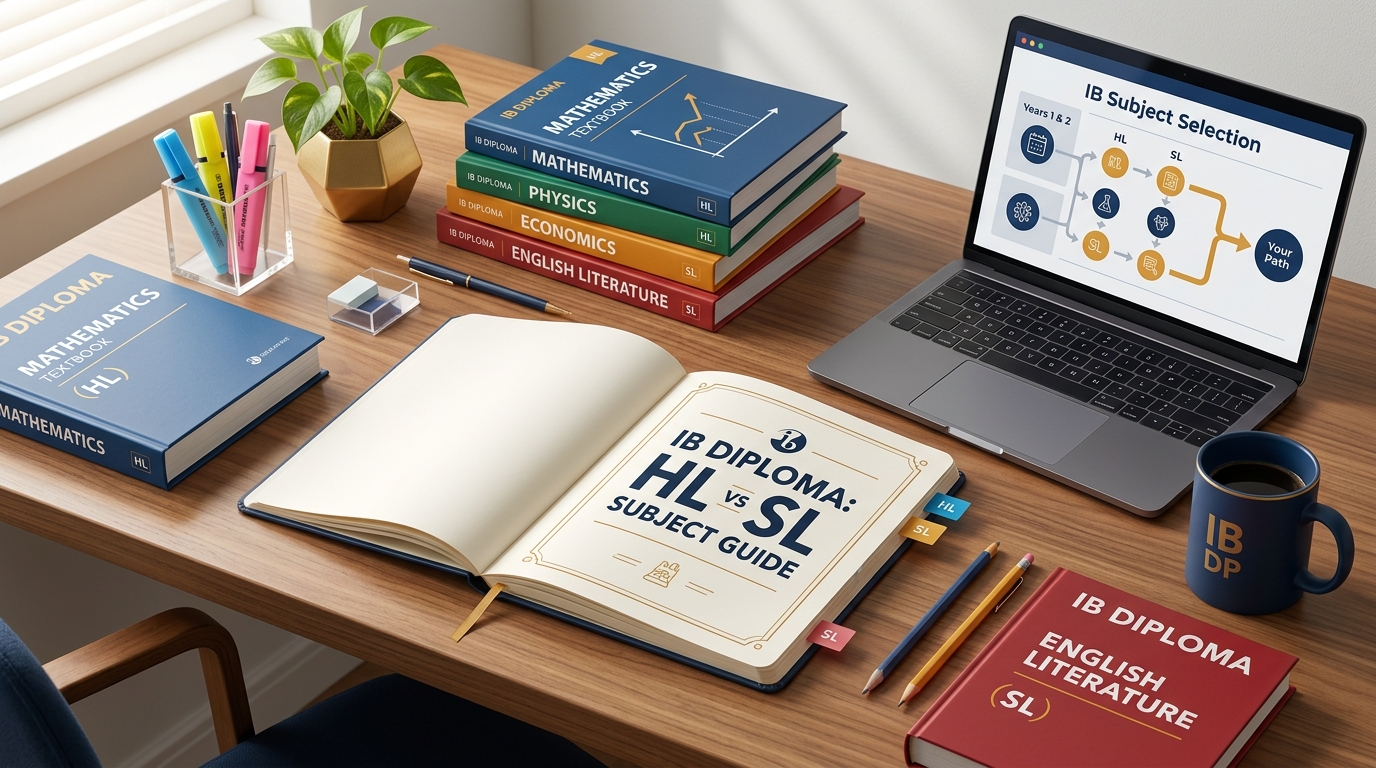
The IB Diploma asks every student to pick one subject from each of six groups: language and literature, language acquisition, individuals and societies, sciences, mathematics, and the arts. Three of the six are studied at Higher Level and three at Standard Level. You may drop the arts and take a second subject from groups one to four.
What usually sits inside each group:
- Group 1, language and literature: usually English Language and Literature, sometimes Hindi as a self-taught option.
- Group 2, language acquisition: Hindi, French, Spanish or German, at a level that matches how long you have studied it.
- Group 3, individuals and societies: Economics, Business Management, Psychology, History, Global Politics, Geography.
- Group 4, sciences: Physics, Chemistry, Biology, Computer Science, Design Technology.
- Group 5, mathematics: Analysis and Approaches, or Applications and Interpretation, each at HL and SL.
- Group 6, the arts: Visual Arts, Theatre, Music, Film.
On top of the six sit the core parts: Theory of Knowledge, the Extended Essay and CAS. The first two add up to three bonus points, so 42 plus 3 gives the familiar total of 45. Our guide on how IB and IGCSE fit together explains which years each programme covers.
Check the school's actual list first
No school offers every subject in every group. Ask the IB coordinator for this year's option blocks, not last year's brochure. Two subjects in the same timetable block cannot both be taken, and that one sheet rules out more combinations than any university requirement.
What is the real difference between HL and SL?
Higher Level subjects are taught for roughly 240 hours across the two years, while Standard Level subjects get about 150. HL covers extra topics, asks harder questions on longer papers, and expects more independent reading. Both levels are graded on the same 1 to 7 scale, and both need a full internal assessment.
The difference students feel most is not the syllabus. It is the weekly load. An HL subject wants steady work, not a push before the test.
| What changes | Higher Level | Standard Level |
|---|---|---|
| Teaching time over two years | About 240 hours | About 150 hours |
| Syllabus | Core plus HL-only topics | Core only |
| Exam papers | Longer papers, extra HL sections | Shorter papers |
| Internal assessment | Required, marked against tougher expectations | Required, smaller in scope |
| Typical homework per week | 4 to 6 hours per subject | 2 to 3 hours per subject |
| How universities use it | Named in offer conditions | Counts towards the total |
Three HL subjects at 4 to 6 hours a week is where students underestimate the Diploma. Add TOK, the Extended Essay and CAS, and the calendar fills fast. Our guide to the IB internal assessment shows how much time the IA quietly takes.
Pick a Higher Level subject you will still work at in November of Year 12, not one that sounds impressive in March of Year 10.
How do universities read your HL subjects?
Universities read your HL subjects as the serious part of your Diploma. A typical UK offer reads like "36 points overall including 6, 6, 5 at Higher Level, with 6 in Chemistry". SL grades count towards the total but rarely appear as named conditions. A wrong HL choice can block a course even with a strong total.
UK and Europe
Requirements are specific and public. Engineering courses usually name Maths and Physics at HL. Medicine names Chemistry at HL, often with Biology. Read the entry requirements page for each course, in the current year, because departments do change them.
United States and Canada
Subject-specific conditions are rarer. Admissions officers look at whether you took a demanding set of subjects and did well in them. If US applications are on your list, plan testing early using our SAT preparation guide for students in India.
India
The IB Diploma is recognised by the Association of Indian Universities, and most Indian universities convert IB points into a percentage using their own formula. For NEET or JEE you still need the right subjects, so Physics, Chemistry and Biology or Maths must be in your six. Check the official information brochure each year, since eligibility wording gets updated.
Which subject combinations suit medicine, engineering, business and design?
There is no single correct combination, but a few patterns come up again and again. Medicine leans on Chemistry and Biology at HL. Engineering leans on Maths Analysis and Approaches with Physics. Business and economics want a solid maths choice. Design and architecture want a portfolio built through Visual Arts or Design Technology.
| Direction | Usual HL choices | Sensible SL choices | Watch out for |
|---|---|---|---|
| Medicine, dentistry, biosciences | Chemistry, Biology, English or Psychology | Maths AA or AI, a language, a group 3 subject | Some medical schools want Maths or Physics at SL too |
| Engineering, computer science | Maths AA, Physics, Chemistry or Computer Science | English, a language, Economics | Most engineering courses expect AA, not AI, at HL |
| Economics, business, finance | Economics, Maths AA, English or Business Management | A science, a language, Psychology | Top economics courses often name Maths AA HL |
| Design, architecture, fine art | Visual Arts or Design Technology, Maths AI, Physics for architecture | English, a language, a group 3 subject | The portfolio usually matters more than the subject list |
| Law, politics, humanities | English, History or Global Politics, Economics | Maths AI, a science, a language | Few law courses name subjects, so pick what you write well |
Group 6 gets dropped in three of those five rows. That is allowed and common. It is also the swap students regret most, so think before you trade away the subject you enjoy.
Do not take a science just to keep options open
An HL science you dislike will pull down two years of grades and eat time your stronger subjects need. If your child is unsure between science and business, an SL science plus a strong HL in something they like usually scores better. The same logic applies to choosing a stream after Class 10.
Should you take Maths AA or AI?
Analysis and Approaches is the algebra and calculus route, with proof, algebraic method and abstract reasoning. Applications and Interpretation is the modelling and statistics route, built around real data, graphs and technology. AA suits engineering, physics, computer science and economics. AI suits design, psychology, business and most social sciences.
Level matters more than families expect. Maths AA HL is one of the hardest subjects in the Diploma, and a 4 in it helps an application far less than a 7 in AA SL. Engineering and pure maths degrees need AA HL. Little else insists on it.
A simple test before you decide
- Get one past paper from AA SL and one from AI SL through your school.
- Try five questions from each, timed, with no worked example open.
- Notice which paper made you think and which one made you shut the laptop.
- Show both attempts to your maths teacher and ask whether AA HL is realistic for you.
If maths has been shaky since Class 9, fix the habits first. Our post on building better maths habits matters more than the label on the form.
Common mistakes students make while picking IB subjects
Most bad IB subject choices come from four sources: copying friends, chasing prestige, believing HL always looks better, and picking around a teacher rather than a subject. Each one feels sensible in Year 10 and expensive by Year 12. The fixes are simple if you catch them before the form goes in.
- Choosing what your friends chose: Timetable blocks split friends apart anyway. Two years is long to sit in a subject you never wanted.
- Taking four HL subjects to look serious: The IB allows it and a few students handle it well. Most end up with weaker grades than they would have had with three.
- Picking a subject because of the teacher: Staff move schools and sections get reshuffled. You are left with the subject, not the teacher.
- Ignoring the internal assessment: Every subject carries one. A student who dislikes long written work should think hard before taking three HL subjects with essay-based IAs.
- Assuming Economics HL means no maths: It has graphs, calculations and quantitative reasoning throughout. Students who chose it to escape maths get a shock by the second term.
- Deciding without reading a single university page: Twenty minutes on three course websites beats a week of family debate.
Can you change an IB subject after the Diploma starts?
Usually yes, but only for a short window. Most schools allow subject or level changes during the first few weeks of Year 11, subject to timetable space. Dropping from HL to SL is often possible later too. Moving in the other direction, or switching subjects after the first term, is much harder because the internal assessment work has already begun.
If your child is struggling in October of Year 11, do not wait for the December report. A level change made early costs a little catching up. The same change in Year 12 can cost a grade.
The honest warning about HL subject tuition
A tutor cannot rescue a badly chosen HL subject in the final term. Good IB subject tutors in Gurugram are also scarce, and most families pay between Rs 1,000 and Rs 2,500 an hour. Choose well in Year 10 and you will need far less of this later.
What to do before you submit the form
Give yourself one focused week. Collect the school's option blocks, check three real university courses, test yourself on the maths route, then decide. Write the reasons down, because you will revisit this decision in a few months and want to remember why you chose what you chose.
- Get the option block sheet: from the IB coordinator and cross out every combination the timetable already forbids.
- Open three university course pages: in the countries you are actually considering, and note the exact HL subjects each one names.
- Do the AA versus AI paper test: above, and get one honest sentence from your maths teacher.
- List your three HL subjects: and beside each write why you can work at it for two years. A missing reason marks the weak link.
- Ask a Year 12 student: what their HL week actually looks like. Their answer beats any brochure.
- Sort out shaky foundations now, before the Diploma starts, rather than in October of Year 11.
For that last step, see our subjects page or how the Back-on-Track bridging program is used before a jump in level. Most IB families reach Dheeru Home Tuitions in the middle of Year 11, and honestly Year 10 would have been the better time. You can also book a free demo class and talk the combination through with a teacher who has taught the subject.