It is early December. Ananya has had the same maths tutor since June, three evenings a week. He has never missed a class and her notebook is neat. The half-yearly result came back at 54, one mark above June.
You do not want to be unfair. Tuition takes time to show. And changing now means finding someone new mid-year, with boards in February.
The hard part is telling a slow start from a bad fit. Here are six signals that usually mean it is time to change, and how to change without a bad scene.
How long should you give a new tutor before deciding?
Give a new tutor about six weeks before you judge results, and two weeks before you judge their method. By week six a good tutor can name your child's exact weak topics, show written work they have corrected, and say what has changed. Marks often move later.
Six weeks is how long it takes to test a child, fill a few gaps and see whether the new habits hold.
| By when | What a good tutor has done | What it looks like when it is not working |
|---|---|---|
| Week 2 | Tested the basics, often from a class below, and told you what is weak | Started from the school chapter, no testing |
| Week 6 | Named two or three weak topics, showed you corrected written work | Only "she is improving", no topic named |
| Week 12 | Fewer careless slips, faster work, a better unit test | Same marks, same mistakes, same explanations |
Pick your measure on day one
Before the first class, write down one thing you will watch. It could be a unit test score, minutes taken to finish ten sums, or whether your child opens the book unasked. Vague memory favours whoever you like more.
Signs your child's tutor is not working out
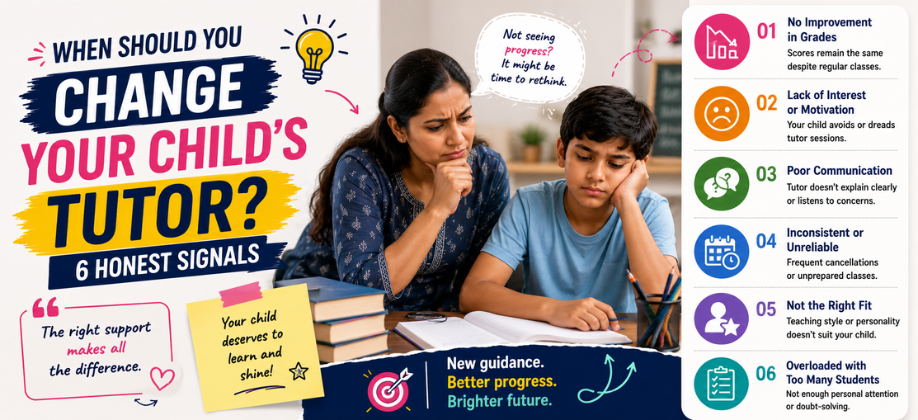
Three signals come straight from the teaching. Nothing measurable has changed after a fair period, your child dreads the class, and the tutor cannot explain a topic in a second way. One of these on its own is worth a conversation. Two together usually means the fit is wrong.
Signal 1: nothing measurable has changed
Measurable does not have to mean board marks. It can be smaller.
- She finishes ten similar sums in twenty minutes instead of forty.
- He loses two marks to careless slips in a unit test instead of nine.
- She starts her homework without you standing behind her.
If none of these has moved in six to eight weeks, and the tutor cannot name anything that has, the teaching is not landing.
Signal 2: your child dreads the class
Every child grumbles about studying. Dread is different. It looks like a stomach ache on Tuesdays, or a child who goes quiet when the doorbell rings.
Ask gently: what happens in class when you get something wrong? "He explains it again" is fine. "He says I already did this chapter" is not.
A child scared of being wrong stops attempting the hard question, and that is the only question that builds anything. If the fear is about the subject rather than the person, our piece on maths anxiety in children is the better starting point.
Signal 3: the tutor cannot explain a topic two ways
This is the strongest signal here and the easiest to test. Ask your child: when you did not get it, did sir explain it differently, or just say the same thing more slowly?
Repeating an explanation more slowly is not a second explanation.
A real second attempt changes the picture. Smaller numbers. A diagram. An example from the cricket field. A tutor with one route gets stuck with every child who cannot take it.
Lateness, missing updates and unchecked homework
The other three signals are about professionalism, not ability. The tutor is regularly late or leaves early, you never get a real progress update, and homework is set but never properly checked. These look like small habits. Over one term they quietly remove weeks of the teaching you paid for.
Signal 4: chronic lateness and shrinking classes
Traffic here is real. Golf Course Road at 6.30 pm is nobody's fault, and one late arrival with a message is just life in Gurugram. A pattern is a decision.
Do the arithmetic once. Fifteen minutes late and five early, three times a week, is an hour lost weekly. Over four months that is sixteen hours, more than a month of classes. Most families here pay between Rs 400 and Rs 1,200 an hour.
Signal 5: no progress updates, or only good news
"She is doing well" is not an update. A real update names a topic: we finished quadratic equations, word problems are still weak, so I am setting five a day.
A tutor who only brings good news is not watching closely. If in five months you never heard something unwelcome, you are buying a service, not an assessment. The checklist in our guide on how to hire a home tutor in Gurgaon is worth repeating mid-year.
Signal 6: homework is set but never checked
Open the tuition notebook tonight and turn to a page from three weeks ago. Look for corrections written inside the working, and check whether wrong steps were marked at all.
A tick at the bottom proves the page was seen. It does not prove the mistake in line four was found. If sums are wrong and unmarked, your child has practised that error for a month. Our guide on helping with homework without doing it shows a properly checked page.
Slow start or bad fit: how to tell the difference
A slow start still has movement inside it. Marks may be flat, but the mistakes change type, the questions get better, and the tutor can name what is improving. A bad fit has no movement at all, only reassurance. Look at the working, not the score.
| What you see | Usually a slow start | Usually a bad fit |
|---|---|---|
| Marks | Flat, but the type of mistake is changing | Same score, same mistakes, month after month |
| Your child's mood | Bored some days, fine on others | Anxious before nearly every class |
| What the tutor says | Names chapters, gaps and a plan | "She needs to work harder at home" |
| Homework | Corrected, mistakes explained next class | Ticked, never discussed again |
Foundation gaps genuinely take longer
If a Class 9 student struggles because fractions never settled in Class 6, six weeks will not fix it and no honest tutor promises otherwise. Ask for a written gap list and a term-long plan. Bridging work like the Back-on-Track program at Dheeru Home Tuitions, on our programs page, is slower on purpose.
When changing the tutor will not help
Changing helps when the teaching is the problem. It does not help when the real issue is sleep, phones, an impossible timetable, or a child who has written off the subject. A new tutor then simply restarts the settling-in period, and you lose another six weeks.
Check these before you blame the tutor.
- Sleep and screens. A child studying at 11 pm with a phone on the desk will not improve for anybody.
- Load. One hour cannot cover maths, science, social studies and English. Something has to be dropped.
- Frequency. Two classes a week will not close a three-year gap, whoever is teaching.
- A recent change. A board switch takes a term to settle, as our guide on changing boards mid-year explains.
- Motivation. If nothing works across every subject, start with a child who does not want to study.
Mind the timing too. Do not change in the last six weeks before board exams unless something serious has happened, because familiarity beats method by then. Work through the last 30 days before board exams instead.
How to raise the problem with your current tutor
Have one direct conversation before you decide anything. Name the exact gap, ask for a plan with dates, and give it three to four weeks. Many tutors improve at once when a parent is specific, because they did not know what you expected. If nothing changes in a month, you have your answer.
Vague complaints get vague replies. "We are not seeing improvement" invites "she needs to work harder". Try this instead.
"Rohan still loses marks on trigonometric identities and will not start homework alone. What is your plan for the next four weeks, and when will we know if it worked?"
A serious answer contains four things.
- The named topics they will fix, in order.
- What changes inside the class, not just more of the same.
- A date for a written test on those topics.
- What they need from you at home.
If all you get is "yes ma'am, I will focus on that", ask the four questions again, one at a time. A tutor who cannot answer them has not been planning.
How to change a tutor without drama
Line up the replacement first, give the notice you agreed, pay the full month, and send one short message rather than a list of complaints. Keep the reason simple and not personal: you are trying a different approach. Nobody has to be proved wrong for a change to be right.
- Find the replacement before you give notice: A three-week gap in December costs more than one awkward fortnight.
- Ask for a handover: Chapters covered, chapters pending, weak topics and the last two test papers.
- Give the notice you agreed at the start, usually two weeks or a month. If you never agreed one, offer a month.
- Pay in full and do not haggle on the way out: Tuition in Gurugram runs on parent groups and referrals.
A message that ends it cleanly
"Thank you for your work with Ananya. We have decided to try a different approach for maths, so the 30th will be her last class. This month's full fee is being sent today." Nothing more needs adding.
What to tell your child
Children read a tutor change as somebody's fault, and usually decide it is theirs. Say it plainly: we are changing how we do maths, not punishing anyone. Then say what stays the same, because that is what they want to know. Same days, same time, same table.
What to do this week
Spend twenty minutes on the notebook, one conversation with your child, and one honest conversation with the tutor. That is enough to tell a slow start from a bad fit. Decide within two weeks, because an undecided term is the most expensive option of all.
- Open the notebook to a page from three weeks ago and look for corrections inside the working, not ticks at the bottom.
- Ask your child what happens in class when they get something wrong, and listen without arguing.
- Write down the one measure you will use: a topic, a test or a habit. Note where it stands today.
- Send the tutor the four-part question: which topics, what changes, when is the test, what do you need from us.
- Diary a date four weeks from now. If nothing has moved, start looking, using the checklist for choosing a home tutor in Gurugram.
Changing a tutor is not a failure, and it is not a judgement on your child. Most families make the change at least once. A demo class with a different teacher costs one hour and usually settles the question.